The Ward 8 Cocktail: A Boston Original from 1898
The Boston cocktail invented at Locke-Ober in 1898 to celebrate Martin Lomasney's election win in the Eighth Ward. The canonical recipe, the history dispute, and where to drink one.
On the eve of the 1898 election, the story goes, a group of Democratic operatives gathered at Locke-Ober on Winter Place to toast Martin Lomasney’s lock on the Eighth Ward. The drink they ordered (rye, lemon, orange, a spoonful of grenadine) outlived the restaurant, the machine, and the ward itself. That’s the legend, anyway. Whether it’s true is another question, and the answer is: probably half.
The Lomasney Story (and Why It’s Probably Half True)
The accepted origin runs like this. November 1898. A back room at Locke-Ober, the Winter Place chophouse that had been pouring drinks to Boston’s political class since 1875. A celebratory round before the votes were even counted, because Martin Lomasney, the Mahatma, the boss of the West End, the man who said “never write if you can speak; never speak if you can nod; never nod if you can wink,” had already delivered the Eighth Ward to the Democratic ticket. Someone, the story says, asked the bartender to invent something for the occasion. The Ward 8 was the answer. It’s a great story. It’s also unverified. David Wondrich, in Imbibe! (2007), credits Locke-Ober as the most likely birthplace but flags the Lomasney provenance as uncorroborated by any contemporary source. No Locke-Ober menu from the period names it. The Puritan Club, on Beacon Street, has been floated as an alternate birthplace; so has the Hotel Vendome on Commonwealth Ave. Neither claim is better documented than the Locke-Ober one. Here’s the part that should make any heritage-minded drinker nervous: the first printed recipe for a Ward 8 doesn’t appear until the 1934 Old Mr. Boston Deluxe Official Bartender’s Guide. That’s a thirty-six-year gap between the alleged invention and the first written record. In cocktail history, gaps that long are where embellishment lives. It is entirely possible the drink was invented in 1898 and simply passed bartender-to-bartender for a generation before anyone wrote it down. It is also entirely possible someone in the 1920s invented a rye sour with grenadine, slapped a Boston-political name on it, and let the legend grow in the telling. The honest answer is we don’t know. The drink exists. The story exists. They may or may not have started in the same room.
The Recipe That Stuck
What we do have, in print, from 1934 forward, is the formula:
- 2 oz rye whiskey
- ½ oz fresh lemon juice
- ½ oz fresh orange juice
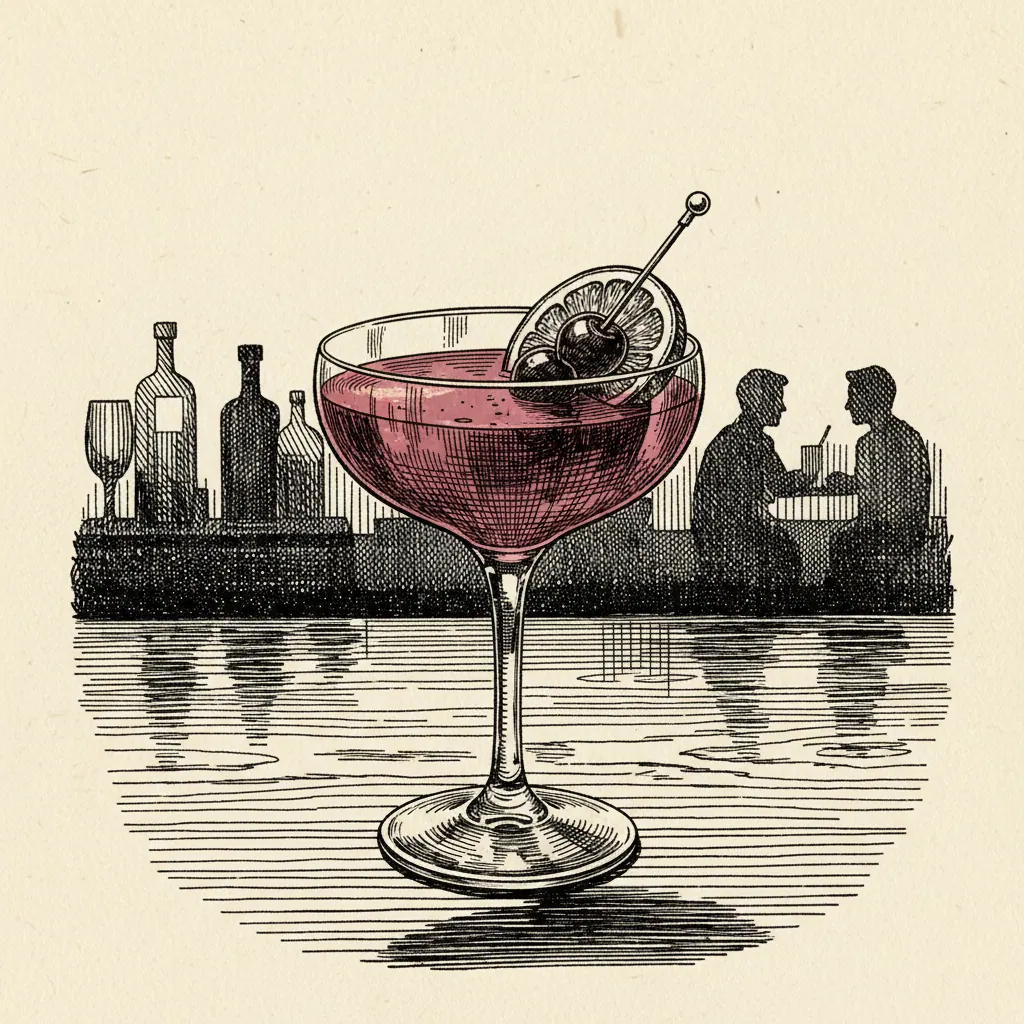
- 1 teaspoon grenadine Shake with ice, strain into a chilled coupe. Garnish with an orange wheel and a brandied cherry: Luxardo or homemade, not the radioactive supermarket kind that taste like cough syrup. A few things matter here. Rye is the historically correct call, and it isn’t a snobbery point. Bourbon makes the drink sweeter and flatter, because bourbon’s corn-forward sweetness layers redundantly with the citrus and grenadine. Rye’s spice gives the sugar something to argue with. The 1934 Mr. Boston specifies whiskey without naming the style, but in 1898 Boston, “whiskey” in a back-room political toast meant rye. Rittenhouse Bonded is the modern workhorse here. Old Overholt also works. Anything 95-plus proof gives the citrus something to push against. The single biggest variable, though, is the grenadine. Real grenadine is pomegranate juice reduced with sugar and a touch of orange flower water. The red corn-syrup product on the supermarket shelf is not grenadine; it’s red. A bottle of Liber & Co. or Jack Rudy will outperform Rose’s by an order of magnitude, and a Ward 8 made with the bad stuff is a Ward 8 made with red dye and an apology.
Boston’s Cocktail Canon, Such As It Is
Boston isn’t a cocktail city the way New Orleans or New York is a cocktail city. The city’s contribution to the canon is small. The Ward 8 sits alongside the Cape Codder and arguments-about-the-Bunker-Hill as the drinks generally accepted as Boston originals, and even those three are contested. New York will out-claim us on most of them. But the Ward 8 has had staying power, and the reason is worth noting. Locke-Ober closed in 2012 after 137 years. The room where the drink was supposedly born (dark wood, German silver, the men’s-grill-only era well behind it but the bones still there) went dark. The cocktail kept being poured. It doesn’t transmit through real estate. It transmits through printed guides (Mr. Boston in 1934, The Fine Art of Mixing Drinks in 1948, every cocktail book since) and through bartender memory, one shift handed off to the next. A bar can close. The drink survives because someone, somewhere, opens a book and reads “2 oz rye, ½ oz lemon, ½ oz orange, 1 tsp grenadine” and pours it again.
Where to Order One in Boston Right Now
Four places worth knowing about, with the caveat that bar programs change and bartenders move. Confirm before you make a special trip. Yvonne’s, on Winter Place, occupies the old Locke-Ober space. It’s a different restaurant: supper-club lighting, a younger crowd, a cocktail program that takes the room’s history seriously without making it a museum. The closest thing in Boston to drinking a Ward 8 where it was born, if it was born there. You sit down, the bartender asks what you feel like, and if you say “Ward 8” they will ask you what kind of rye you want and mean it. This is the version for people who want to taste the variable. The Hawthorne in Kenmore Square and No. 9 Park on Beacon Hill each pour their own take. The Hawthorne tends toward the classical reading; No. 9 Park’s bar program has historically pushed the citrus harder. The variation between the two is, frankly, the point. There is no single canonical Ward 8, because there is no single canonical 1898 recipe. Every version is a reading.
Making It Right at Home
Fresh-squeezed citrus only. The drink is small, three ounces of liquid before dilution, and there’s nowhere for bottled juice to hide. Bottled lemon tastes like bottled lemon, and bottled orange tastes worse. The dry-shake question comes up. Modern technique-driven bars sometimes dry-shake first (no ice) to build foam, then shake again with ice to chill. The 1934 Mr. Boston doesn’t specify. Do whichever gives you the texture you want; the Ward 8 isn’t a sour with egg white, so the foam stakes are lower than they would be for a Whiskey Sour. A single hard shake with plenty of ice is the traditional read. On the rye: Rittenhouse Bonded at 100 proof is the easy answer. Old Overholt Bottled-in-Bond also works. Sazerac Rye if you want something a little more aromatic. Anything below 90 proof and the drink starts to feel waterlogged; the whole architecture depends on the rye having enough backbone to carry the citrus and the grenadine without folding. Make one tonight. Pour the second one slower. Whether or not Martin Lomasney ever raised a glass on Winter Place in November 1898, the drink in front of you has been poured in this city, under this name, for almost ninety years of documented history and probably longer. That’s enough heritage for any cocktail to carry.