The New England Spring Peepers Calendar: When and Where to Hear the First Frogs
When New England's spring peepers start calling, where to hear them, and the nine-day shift in the chorus window scientists have measured since 1971.
The first warm dusk after the soil clears 50 degrees, a pond in eastern Massachusetts will sound like a thousand small bells shaken at once. That’s Pseudacris crucifer, the spring peeper, and it’s the most reliable signal that New England winter is actually done. Not the crocuses, which lie about the weather. Not the red-winged blackbirds, which arrive on a hunch and sometimes regret it. The peepers are committed. When the chorus starts, you can put the snow shovel away. What follows is a field guide for listening: what’s making the noise, when to expect it in your part of the region, where to go if you don’t have a pond of your own, and what’s happening to the calling window as the soil warms earlier each decade.
What You’re Hearing (and Why It’s Only the Males)
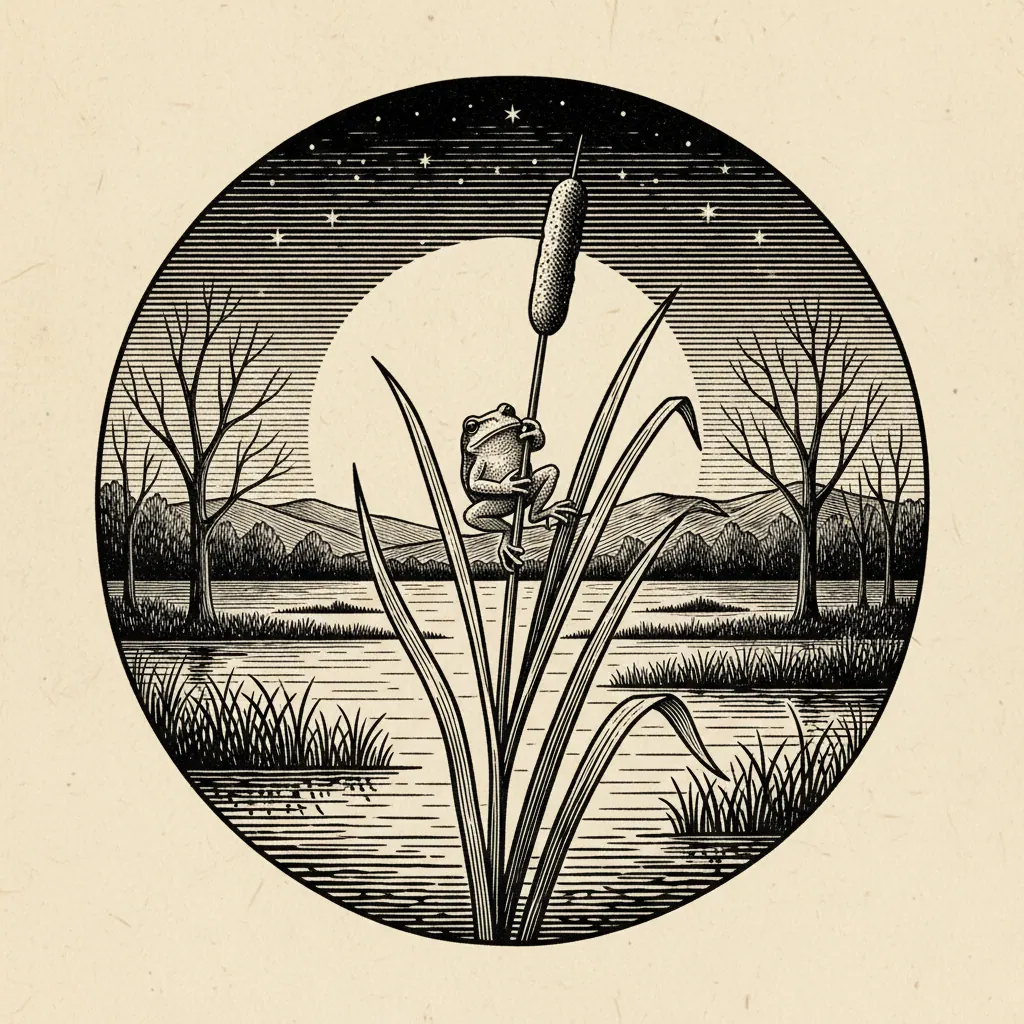
A spring peeper is roughly the size of a nickel. Tan or olive, with a dark X marked across its back (crucifer means cross-bearer), and a throat that, in a calling male, balloons out to nearly the size of the rest of the frog. That throat is the resonator. A single peeper at close range will register around 90 decibels; a full chorus tops 95. For a frog you can cover with a quarter, that is a structural feat. Only the males call. The chorus is a mating broadcast, and the call rate, the peeps per minute, climbs with air temperature in a near-linear way. Cold-night peepers call slowly and quietly. A 60-degree night sounds like a different species. The other thing worth knowing is how they got there. Spring peepers don’t burrow below the frost line the way wood frogs and a few salamanders do. They winter under leaf litter and loose bark, often with ice forming inside their bodies. Glucose floods the blood and acts as cryoprotectant, keeping cell walls from rupturing as the frog partially freezes. When the thaw comes, the heart restarts. It’s one of the more remarkable survival strategies in the New England woods, and it’s happening under the dead leaves in everyone’s back forty. The chorus tends to arrive in waves over two or three weeks rather than all at once, even at a single pond. The earliest males call from the warmest microhabitats, like south-facing edges and shallow water that warms in the afternoon, while the deeper and shadier zones lag behind. So a pond that sounds half-full on April 5th may be deafening by April 15th and still going strong on May 1st.
The State-by-State First-Call Calendar
Latitude and elevation set the schedule. Treat these dates as the warm-year early end of a roughly two-week window. Coastal Massachusetts and Rhode Island: late March in a warm year, first week of April in a cold one. The salt-moderated pockets along the South Shore and Narragansett Bay tend to lead the rest of the state by several days. Connecticut lower river valleys and the Blackstone corridor: early April, often a week ahead of the higher inland Massachusetts ponds. The Connecticut River valley acts as a thermal funnel; the Blackstone corridor benefits from urban warmth around Worcester and Providence. Vermont, New Hampshire, and southern Maine: mid-to-late April. Elevation pushes the date back roughly three to five days per 1,000 feet of gain, so a pond in the Champlain Valley may be in full chorus while one a half-hour east in the Green Mountains is silent. Northern Maine and the White Mountains: late April into the second week of May. At higher altitude the chorus can run right into Memorial Day weekend, which surprises people who assume peeper season is a March-April affair. It isn’t, in the north. It’s a May affair.
Five Reliable Peeper Ponds with Public Access
These are the easy ones, places where you can park, walk a short distance, and listen without trespassing or wading. Great Meadows National Wildlife Refuge, Concord, MA. The Dike Trail impoundments are the gold standard for accessible peeper listening in eastern Massachusetts. Park off Monsen Road, walk to the edge of the gravel, and the chorus comes off both impoundments at once. You don’t have to enter the marsh; in fact, you shouldn’t. Mass Audubon’s Drumlin Farm, Lincoln, MA, and the Sudbury River impoundments downstream. Drumlin Farm has evening parking and the back ponds are far enough from Route 117 that road noise doesn’t compete. The Sudbury River impoundments, accessible from several pull-offs along Sherman Bridge Road and Lincoln Road, call slightly later but louder. Dead Creek Wildlife Management Area, Addison, VT. The Brilyea access road parking area puts you within earshot of three separate choruses on a still night. This is also one of the better places in the region to hear peepers stacked with wood frogs and American toads, which call in roughly overlapping windows. Scarborough Marsh, ME. Maine Audubon’s center on Pine Point Road is the staging point. The back freshwater impoundments call later than the inland ponds (salt influence cools and slows the breeding cycle), so this is a useful late-season backup if you missed the peak inland. A fifth pond is whichever one is closest to your house. Drive ten minutes after dark in April and roll the window down. If there’s standing water and a wooded edge, there are probably peepers.
An Evening Listening Protocol (and How to Count for Science)
Arrive 30 minutes before sunset. The chorus typically builds at dusk, peaks 30 to 60 minutes after full dark, and runs hardest when air temperature stays above 50°F. A cold front shuts the whole thing down within an hour. Stand about 50 feet back from the water’s edge. Closer than that and the volume saturates your ability to distinguish individual callers; you stop hearing a chorus and start hearing one undifferentiated wall of sound. From 50 feet you can count clusters and pick out the loudest males. If you want the listening to count for something beyond personal pleasure, submit observations to FrogWatch USA, run by the Association of Zoos and Aquariums, or, in Vermont, to the Vermont Atlas of Life. Both use the same 0–3 calling index: 0 for no calls, 1 for individuals countable with space between, 2 for overlapping calls with individuals still distinguishable, 3 for a full chorus where individuals can’t be separated. The protocol takes about three minutes per visit. Bring a thermometer for water and air both. A calling-index number without temperature is interesting; with temperature, it’s data. Three or four seasons of consistent observation at the same pond is the kind of record that researchers genuinely use.
The Window Is Shrinking: What Backyard Listeners Should Know
The reason the protocol matters now in a way it didn’t a generation ago is that the calling window is contracting. USA National Phenology Network records show the peeper calling window across the Northeast shortened by roughly nine days between 1971 and 2010. The chorus starts earlier and, in many ponds, ends earlier too. Air temperature on the night you go out tells you whether the chorus will be loud. Soil temperature in the weeks before tells you whether the chorus will exist at all on the date you’ve circled. A late cold snap that leaves the air warm but the ground frozen produces a quiet April; a mild February that thaws the leaf litter early produces a peeper season that may be largely over by the time anyone thinks to listen. Practically, this means the window to catch a peak chorus is narrower than it used to be, and missing peak by a week increasingly means missing it altogether. The countermove is small and almost embarrassingly low-tech: keep a log. One pond, one notebook, the date of first call and the date the chorus peaks and the date it ends. Air temperature and water temperature if you have them. After three or four seasons, the log becomes meaningful as the pond’s own record, against which any given spring can be measured. After ten seasons it becomes the kind of dataset a researcher would write back about. The peepers will tell you when winter is over. Whether you’re listening closely enough to notice the date drifting earlier each decade is up to you.