Shirred Eggs: The Forgotten New England Breakfast
Eggs baked in a ramekin with cream and butter — the Boston hotel breakfast every grand inn served from 1890 to 1960 and almost nobody makes at home anymore.
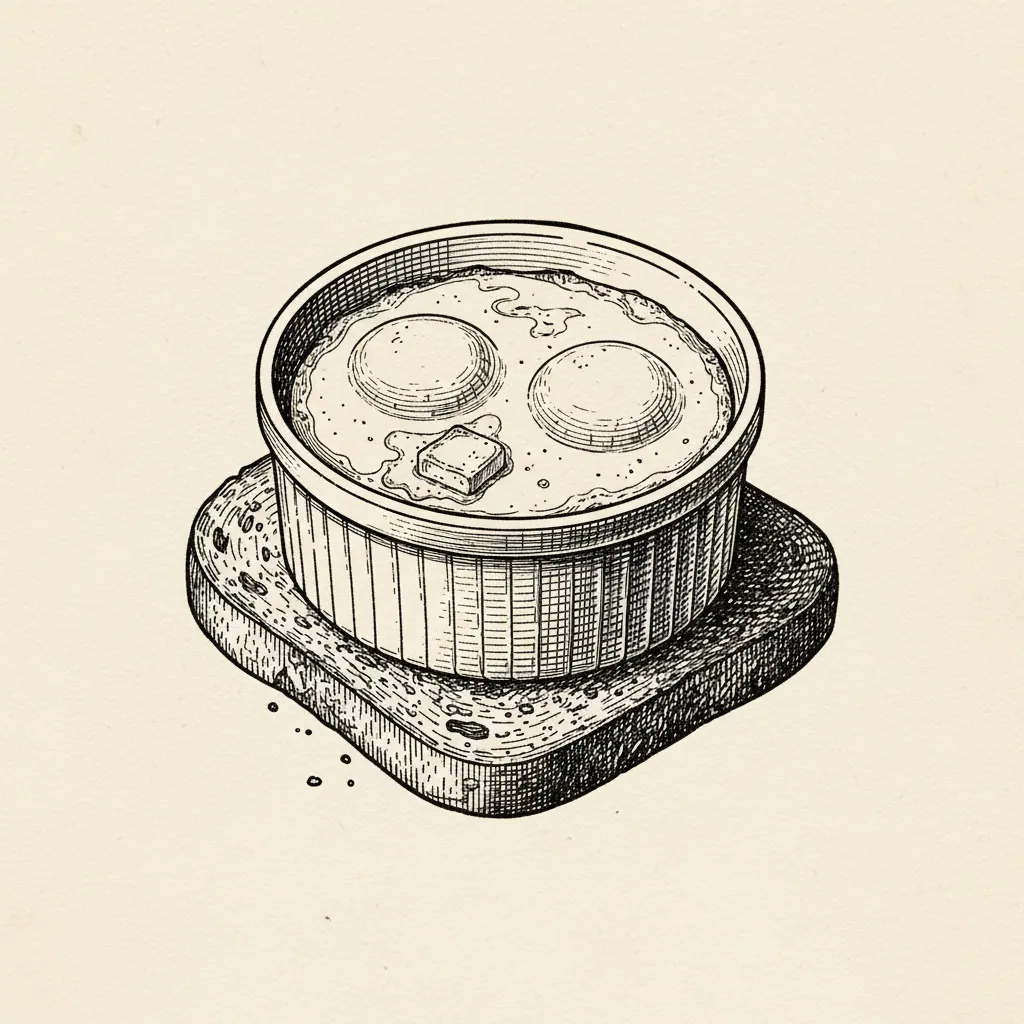
Shirred eggs are eggs baked in a ramekin with cream and butter, and that’s the whole technique. From roughly 1890 to 1960, every serious New England seaside hotel had them on the breakfast card. The Wentworth in New Castle. The Mount Washington up in Bretton Woods. The Cliff Walk places in Newport. The Black Point Inn at Prouts Neck. Order breakfast at any of them in 1925 and shirred eggs were sitting there on the menu next to the kippers and the johnnycakes, two-fifty a portion, served in the ramekin they came out of the oven in. Almost nobody makes them at home anymore. That’s a small tragedy, and it’s worth fixing on a Sunday morning when you’ve got fourteen quiet minutes and a clean ramekin.
How a French Technique Became the Boston Hotel Breakfast
The dish is French to start with. Oeufs en cocotte, eggs baked in a small lidded dish with cream, was a Lyonnaise standard by the 1880s. The technique crossed the Atlantic the way most upscale hotel cooking did in that era: through the kitchen brigades of the grand hotels, where the chef was usually French or French-trained and the menu read in two languages. By the turn of the century the dish had a foothold in Boston and the resort circuit beyond it. Shirred eggs require three things a railroad-era luxury hotel could deliver easily and a tenement kitchen could not: ceramic ramekins in matched sets, a hot oven held steady at 375°F, and twelve unhurried minutes between the order and the plate. The hotels had brigade kitchens with bread ovens already running for the morning rolls. They had stewards who could carry six ramekins at a time on a silver tray. The dish was modern in the 1910 sense, meaning it announced that you were eating somewhere with a real kitchen behind a real dining room, not at a boarding-house table. It became, in other words, the breakfast you ate when you were on vacation. Which is exactly how most New Englanders encountered it.
Why Shirred Eggs Disappeared After WWII
The fall happened fast. Three things did it. Gas stoves arrived in every postwar kitchen, and once a woman could fry an egg in ninety seconds on her own range, the appeal of a baked egg that took fifteen minutes started to look thin. The omelet and the fried egg won the home breakfast on speed alone. Then the diner counter rewrote the rules of the cooked-out breakfast. Short-order culture in the 1950s rewarded eggs that hit the plate in three minutes: over easy, scrambled, sunny side up, all of them faster than anything you could bake. A line cook in a North Shore diner in 1958 was turning out forty-two egg orders an hour. He couldn’t have plated a shirred egg if you’d paid him double. And the hotel breakfast itself shrank. By the 1970s the grand-hotel breakfast room had become the breakfast buffet, and the labor-intensive ramekin course was the first thing on the chopping block. A buffet wants chafing dishes of scrambled eggs, not a kitchen pulling individual ramekins on the eight-minute mark. The dish that had been the signature of the Edwardian breakfast became unprofitable in one generation, and it left the menus quietly, without anyone noticing it had gone.
The Recipe (Classic Boston Shirred Eggs)
This is the version you’d have eaten at a Boston hotel breakfast in 1930. It’s also the version that’s hardest to improve on. For one ramekin (one serving):
- 1 tablespoon unsalted butter, softened
- 2 tablespoons heavy cream, divided
- 2 large eggs
- Salt and freshly ground black pepper
- 1 tablespoon grated sharp cheddar (Cabot or Vermont Creamery)
- A pinch of flaky salt, to finish Directions:
- Heat the oven to 375°F. Generously butter the inside of a 6-oz ceramic ramekin, bottom and walls; don’t be shy.
- Add 1 tablespoon of the cream to the bottom of the ramekin.
- Crack the eggs in carefully, side by side, without breaking the yolks. Season with salt and a few grinds of pepper.
- Spoon the second tablespoon of cream over the top, then sprinkle the grated cheese around the edges, leaving the yolks visible.
- Bake for 12 to 14 minutes. The whites should be just set; the yolks should still wobble when you nudge the dish. Pull at 12 minutes the first time you make these and check; ovens vary, and a shirred egg goes from perfect to overcooked in about ninety seconds.
- Finish with a pinch of flaky salt. Serve immediately, in the ramekin, with buttered toast for dipping. The yolks are the point of the dish. If they set hard, you’ve made a small casserole. If they stay liquid under a tender white, you’ve made shirred eggs.
Three Regional Variations Worth Knowing
The base recipe traveled the New England coast and picked up regional touches at each stop. Classic Boston. Cream and butter only, finished with flaky salt. This is the Parker House version: restrained, dependent on the quality of the eggs and the cream. Use the best you can find. A good egg from a farm stand and a real heavy cream (not ultrapasteurized if you can help it) will outwork any garnish. Newport. Cream, a teaspoon of minced chives, and a tablespoon of grated Vermont cheddar stirred into the cream before the eggs go in. The chives go on the bottom with the first spoon of cream so they steam under the eggs rather than burning on top. Slightly richer, slightly greener, and the version most people respond to if they’ve never eaten shirred eggs before. Maine coast. Cream and a small handful of flaked smoked haddock, the version that ran on the breakfast menu at the Black Point Inn at Prouts Neck through the mid-century. Use about an ounce of smoked haddock per ramekin, broken into flakes, scattered under the eggs with the first spoon of cream. The fish warms through and perfumes the eggs without overpowering them. If you can find Maine-smoked haddock, use it; if not, a good Scottish finnan haddie substitutes well.
Equipment: What Actually Works
The ramekin matters more than people expect. A 6-oz ceramic ramekin is the standard, and there’s a reason. The thermal mass of the ceramic gives you the gentle, even bake the dish requires; the heat moves into the egg slowly enough that the white sets before the yolk firms. This is the entire mechanism of the recipe. Cheap thin ramekins work; the supermarket brand with the fluted edge works. What you want is the weight in your hand. A Pyrex custard cup of similar volume substitutes if you don’t own ceramic ramekins. The glass is thinner, so the eggs cook a touch faster; pull at 11 minutes and check. A muffin tin does not work. The metal is too thin, the heat moves too fast, and the eggs overcook before the yolks set right. You’ll get a rubber disc. Don’t. One ramekin per person is the rule. Two eggs per ramekin is the yield. Don’t try to scale up by doubling the eggs in one dish; the timing breaks and the top egg overcooks while the bottom one stays raw. If you’re feeding four, run four ramekins side by side on a sheet pan. They all come out at the same minute mark. The dish was built for a Sunday morning when you have fourteen minutes and the oven’s already on for something else. That’s the hotel-breakfast logic: let the oven do the work while you read the paper. It’s still the right logic. The technique didn’t disappear because it stopped being good. It disappeared because we stopped being patient. Worth reversing on a Sunday in October, with a ramekin and a piece of toast, and seeing what the Wentworth dining room knew in 1925.