The Boston Steak Tip: How a Bar Cut Became a New England Standard
How a cheap cut became a New England standard. The Italian-marinade canon, rice-pilaf-and-blue-cheese serving rule, and the bars that have served them the same way since 1985.
Order steak tips outside Route 128 and you’ll get a blank stare. Order them at the Cottage Park Yacht Club in Winthrop on a Friday at six and you’ll get the most quietly perfect bar dinner in New England: a cheap cut of beef, an Italian dressing marinade, a scoop of Near East rice pilaf, and a Bud. There’s nothing on the plate that costs more than it has to. There’s nothing on the plate a Greater Boston regular hasn’t been eating since middle school. And there is, somehow, nothing else in American regional food that quite resembles it. Steak tips are a Boston thing. Not New England, but Boston, with a perimeter that runs from the North Shore down through Quincy and out to about Worcester before the order starts to get blank looks at the bar. Inside that perimeter, “tips” is its own word, its own dinner, its own Friday night.
What a Steak Tip Actually Is
The cut is bottom sirloin flap. Almost everywhere else in the country it goes by another name: sirloin tip in some butcher cases, tri-tip out in California, bavette in a French kitchen, flap meat in the trade. In Greater Boston, it’s just “tips,” and the word does all the work. It is, historically, the cheap end of the steer. The piece a butcher couldn’t move as a steak because the grain runs strange and the shape doesn’t portion cleanly. Marinated and grilled hot, though, it’s one of the most flavorful pieces of beef on the animal: beefier than tenderloin, more tender than skirt, and built for a hot grate. A note on bar menus, because this matters when you’re paying: “steak tips” and “tenderloin tips” are not the same thing. Tenderloin tips are the trimmed scraps of filet, mild and pricey; steak tips are the sirloin flap. A bar that lists both is being honest. A bar that lists “tenderloin tips” at $14.99 is selling you something else, probably top round, probably tenderized. The honest places say tips and mean it.
How the Cut Became a Boston Bar Order
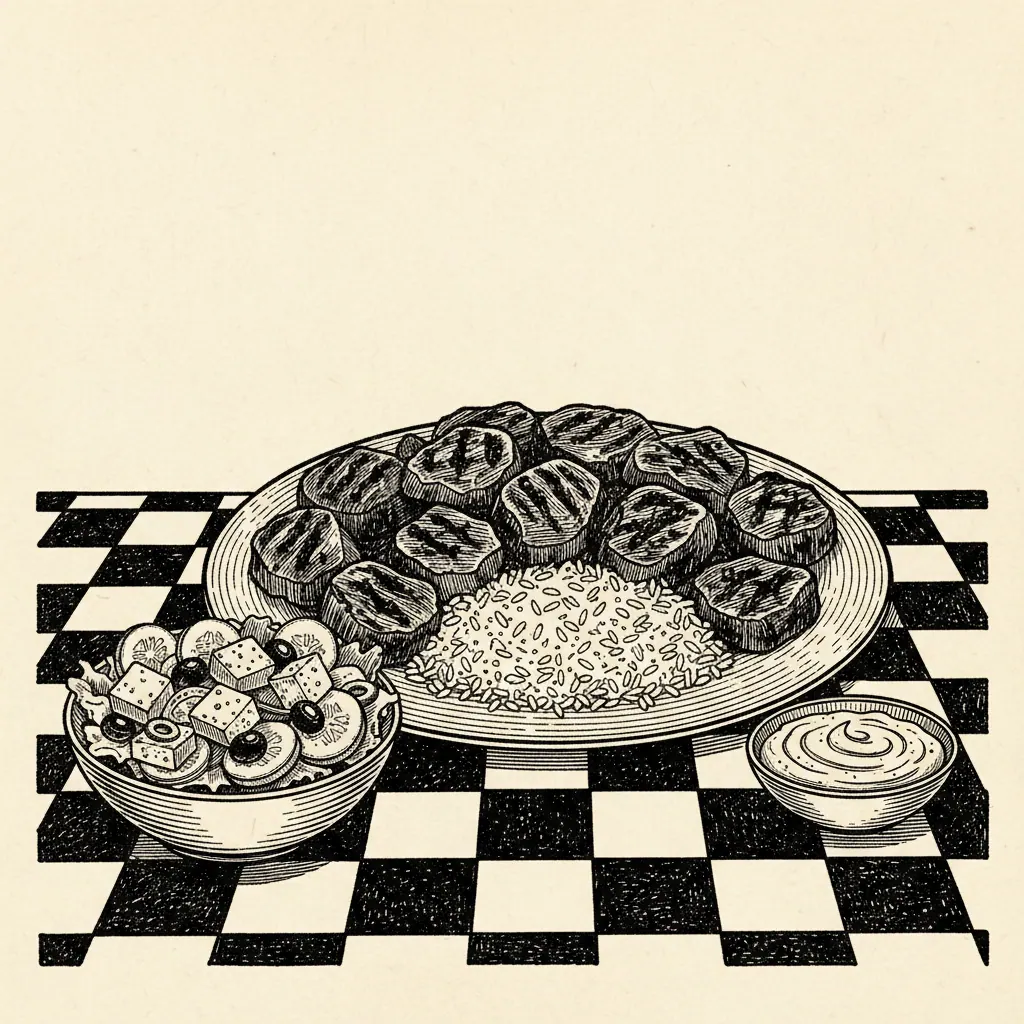
The story everyone tells is the 1950s-and-60s neighborhood bar story, and it’s right. Eastie, Quincy, Saugus, Revere: bars working with what was cheap and grillable for a clientele that wanted dinner with the beer. Italian-American kitchens had the oregano and the red wine vinegar; Irish-American kitchens had the meat-and-potatoes instinct. They converged, more or less by accident, on oil-and-vinegar Italian dressing as the marinade. The acid did the tenderizing work that the cut needed. The oregano gave it a flavor profile that read as “restaurant” rather than “home cooking.” The price let the bar charge $3.95 for a plate and still make money on the beer. By the mid-1970s, “tips and a Bud” was the Friday-night working-class order across the metro, the way a fish-and-chips Friday was the order in Gloucester or a Coney was the order in Detroit. Then, around 1985, the form froze in place. The plate as it’s served today, tips and pilaf and blue cheese and Greek salad and beer, is the plate that was being served when Reagan was in his second term. Restaurants have come and gone. The plate hasn’t moved.
The Marinade Canon
Two bottles do the bulk of the work in Greater Boston kitchens, and they have for forty years. Ken’s Steak House Italian is the older one. Ken’s started as an actual restaurant on Route 9 in Framingham in 1941, and the bottled dressings came out of that kitchen. It’s the heritage answer. Newman’s Own Italian became the 1990s default, partly on Paul Newman’s marketing reach and partly because it tastes a little brighter, a little less sweet. Either works. Most bars use one or the other and won’t tell you which. If you’re making it at home, the homemade version is better and takes ten minutes:
- 1/2 cup olive oil
- 1/4 cup red wine vinegar
- 4 cloves garlic, crushed
- 1 tablespoon dried oregano
- 1 teaspoon red pepper flakes
- Salt and pepper Whisk it together, pour it over two pounds of tips in a zip bag, and refrigerate four to twenty-four hours. No longer than twenty-four, because the acid will start to break the meat down past tenderness into mush. Grill hot and fast over direct heat, four minutes a side for medium-rare, and let the meat rest five minutes before you slice across the grain. The reason the acid-and-oregano profile works specifically on this cut is structural. Sirloin flap has long, loose muscle fibers that take marinade deep. The vinegar tenderizes; the oil carries the herb flavor into the meat instead of letting it sit on the surface. A steakhouse rub on a ribeye is about the crust. A tips marinade is about the inside.
The Plate, As It’s Served in 90 Percent of Greater Boston Bars
Rice pilaf. Near East brand, from the box, the Massachusetts default since the box hit shelves in the 1960s. Near East was founded by an Armenian-American family in Boston, which is why the pilaf is here and not, say, mashed potatoes. The brand was local before it was national, and the bars bought what was being sold to them. Blue cheese dressing on the side, for dipping. Bottled, usually. Not steak sauce. Not chimichurri. Not aioli. Blue cheese, which sounds wrong on paper and is exactly right in practice, because the funk cuts the marinade’s acid and the beef’s fat in one move. A small Greek salad with pepperoncini. A pint of domestic. That’s the order. If a bar serves you tips with roasted vegetables and a microgreen salad, that’s a different restaurant trying to sell you a different thing, and the price will reflect it.
Where to Eat the Canonical Version in 2026
The Cottage Park Yacht Club in Winthrop is the case for the original. It’s a private club with a public dining room, the kind of place where the bar still runs on cash, and the tips on a Friday night are the dinner the room is built around. The Hilltop Steak House, with its giant cactus, the line out the door, and the Western-themed dining rooms that defined Route 1 dining for fifty years, closed in 2013, and the cactus came down. But the Route 1 steakhouse instinct didn’t go with it. Giuseppe’s and the handful of successor places up that stretch are still serving tips at a price the Hilltop would recognize, even if the room is smaller and the wait is shorter. J. Dempsey’s in Marblehead is the North Shore answer, a neighborhood bar where the tips outperform what the rent would suggest they should. And there are a dozen other places like it across the metro: the unmarked corner bars in Quincy, the VFW kitchens in Medford, the Knights of Columbus halls that put tips on the menu every other Friday, where the version on the plate is the version that was on the plate in 1985, because nobody saw a reason to change it. That’s the case for the dish, in the end. It is one of the few American regional foods that is still being served, in the same form, in the same neighborhoods, by the same kind of people, at roughly the same price-to-effort ratio it was forty years ago. The Bud is colder. The pilaf is from the same box. Order it next Friday.