Ribbon Candy: The Heritage Christmas Candy and Where It's Still Hand-Pulled
The pleated, hand-pulled Christmas candy that used to sit in every New England grandmother's cut-glass dish — and the Brockton factory still making it the old way.
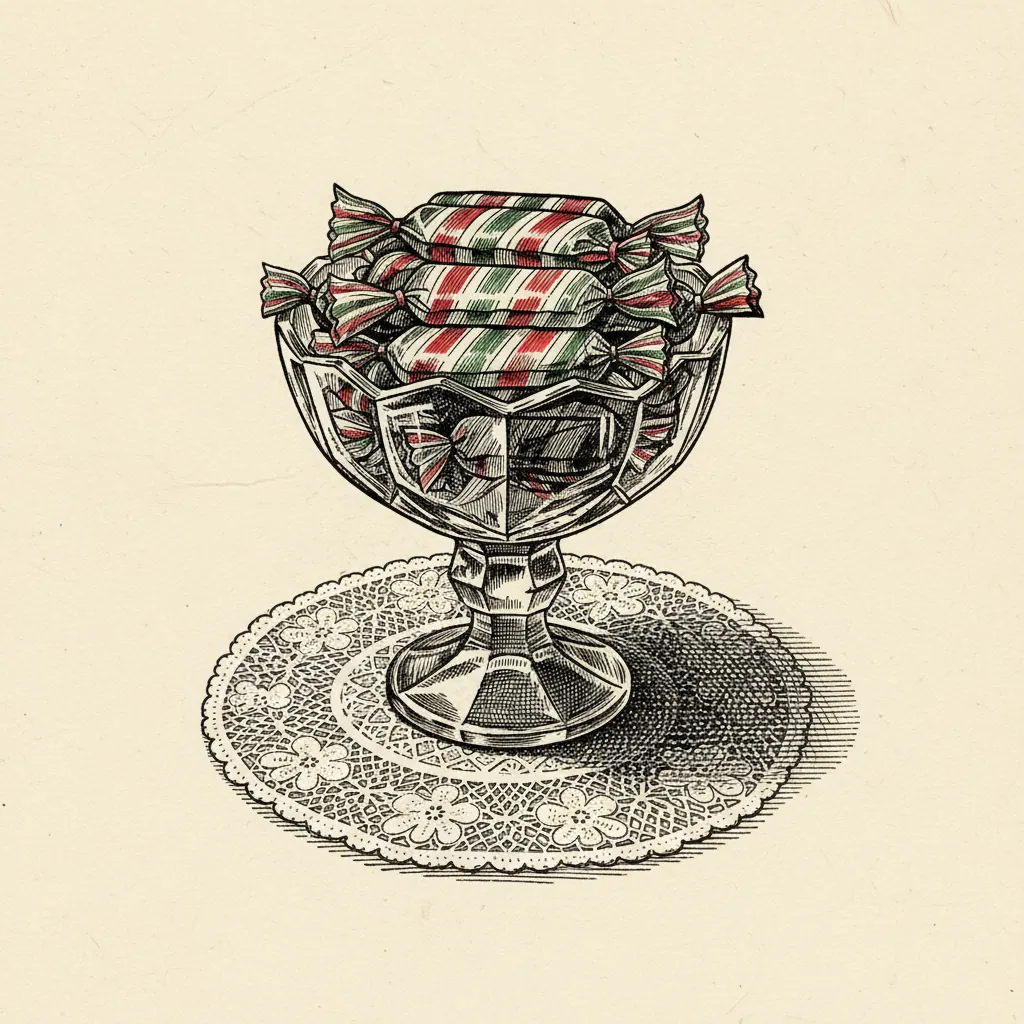
The pleated, translucent fan of striped sugar that sat in a cut-glass dish on every New England grandmother’s coffee table from 1920 to 1990 was not decoration. It was dessert. And you were supposed to break it with a small silver hammer. Most of what’s sold as ribbon candy now, the cellophane bags hanging on a peg by the supermarket checkout in early November, is a different candy with the same name. The real thing is hand-pulled, set in an accordion pleat while the sugar is still hot enough to scald, and made by a shrinking handful of New England houses that have kept the technique alive because nobody has figured out how to mechanize it at scale.
What Ribbon Candy Actually Is
Ribbon candy is a hard-pulled sugar candy that traces back to the 1840s. The technique is older than that, since sugar pulling on a hook is medieval, but the ribbon form, with its laminated stripes and crimped pleat, settled into its current shape in the middle of the nineteenth century and hasn’t changed much since. The pleat is the tell. Only hand-crimped candy holds that accordion fold, because the fold has to be set while the sugar is still pliable, somewhere around 200°F. Below that, the sugar shatters. Above it, the pleat slumps. The window is narrow on purpose, and the working candy has to be folded, striped, and crimped before it closes. The translucent stripes come from layered batches of differently colored sugar, each cooked separately and then laid together before the pull. When the pulled rope is stretched and folded, the stripes embed into the body of the candy rather than sitting on the surface. Hold a piece of real ribbon candy up to a window and the color runs all the way through. Hold a supermarket piece up and the color sits on top like a printed label.
The New England Houses That Made It
The Northeast was the center of American confectionery in the nineteenth century, and Massachusetts in particular held a remarkable density of small candy houses well into the twentieth. A few of them are still pulling ribbon candy by hand for the holiday run. F.B. Washburn Candy of Brockton, founded in 1856, is the oldest still operating. The Washburn family has run it for five generations, and the ribbon candy season, roughly October through Christmas, is the part of the year the factory still works the way it did a century ago. Hilliards House of Candy in Easton, Massachusetts, in operation since 1924, joined the seasonal hand-pulled trade and still runs ribbon candy alongside its better-known chocolates. These three are not a comprehensive list. There are a few smaller producers, mostly seasonal, and a handful of confectioners who pull ribbon candy as a holiday show piece rather than a year-round product. But for an order of real hand-pulled ribbon candy in 2026, the realistic shortlist starts here.
The Four-Minute Window
The work itself is fast and unforgiving. Sugar is boiled to the hard-crack stage, somewhere above 300°F, and poured onto a cooling slab. As it sits, the outer edges set first, and the candy maker folds those edges back into the molten center to even the temperature. Once the mass is workable, opaque, glossy, and just cool enough to handle with gloves, it goes onto a steel hook on the wall. The hook does what hand-pulling has done for centuries: it incorporates air, lightens the color, and gives the candy its characteristic translucent body. The stripes, cooked in separate batches and kept warm, are pressed onto the pulled rope and laminated in. Then the rope goes to the table to be crimped, by hand, into the pleat. From the moment the sugar hits the slab to the moment the last pleat is crimped, the working time is under four minutes. Once the candy drops below roughly 180°F, it shatters instead of folds. That’s the entire reason the process has never been mechanized at scale: a machine fast enough to crimp at temperature would cost more than a candy house earns in a decade of holiday seasons, and a slower machine just produces broken candy. So the work stays on the table, with people, the way it has been since the 1840s.
Why the Supermarket Version Is a Different Candy
The bagged version on the supermarket peg is machine-extruded in straight ribbons and packaged for year-round shelf life. It is structurally unable to hold the pleat, because the extrusion process sets the sugar at the die, and a fold crimped after that point would crack rather than bend. The flavor is single-batch rather than laminated, which is why the stripes look printed. There is no fold to embed the color into the body of the candy, so the colored sugar is applied as a surface coating during extrusion. It tastes fine. It is recognizably the same family of confection. But sitting next to a piece pulled in Brockton last week, it reads as a different object. This isn’t snobbery, and it isn’t a complaint about industrial candy in general. It’s a structural fact about the two methods. One produces a fan with embedded stripes that shatters along the pleat lines into eating-sized pieces. The other produces a straight ribbon with surface color that breaks into long shards. Both are sold under the name “ribbon candy” because the name predates the machine.
The Silver Hammer and the Forgotten Use
The piece of ribbon candy in the cut-glass dish was not the eating candy. It was the display. The eating candy came at the end of the Christmas meal, when somebody, usually whichever grandchild had been eyeing the dish all afternoon, was handed a small silver hammer kept beside it. The pleat shatters cleanly along the fold lines into fragments roughly the size of a fingernail. Those fragments were the serving size. The fan was the showpiece, broken down at the end of the night, and the dish was refilled the next morning with another fan from the box on the sideboard. The silver hammer is the part that’s mostly gone. Nobody under sixty seems to remember it. The candy survived the twentieth century in cellophane bags; the ritual didn’t. For the real thing in 2026, the order is direct. Washburn’s runs a factory store in Brockton and ships by mail through the holiday season. Sevigny’s and Hilliards both ship as well, and both sell out of the hand-pulled inventory before Christmas most years. The season is short, the working window is four minutes wide, and the candy has never been made any faster than that. If a fan of real ribbon candy shows up in a cut-glass dish on a New England coffee table this December, find the hammer.