New England Diners That Survived: A Field Guide
New England's diner survivors — mostly pre-1965 manufactured cars still serving real food, plus a few honest heirs. What to order at each, how to read the survivors' tells, and why the diner matters.
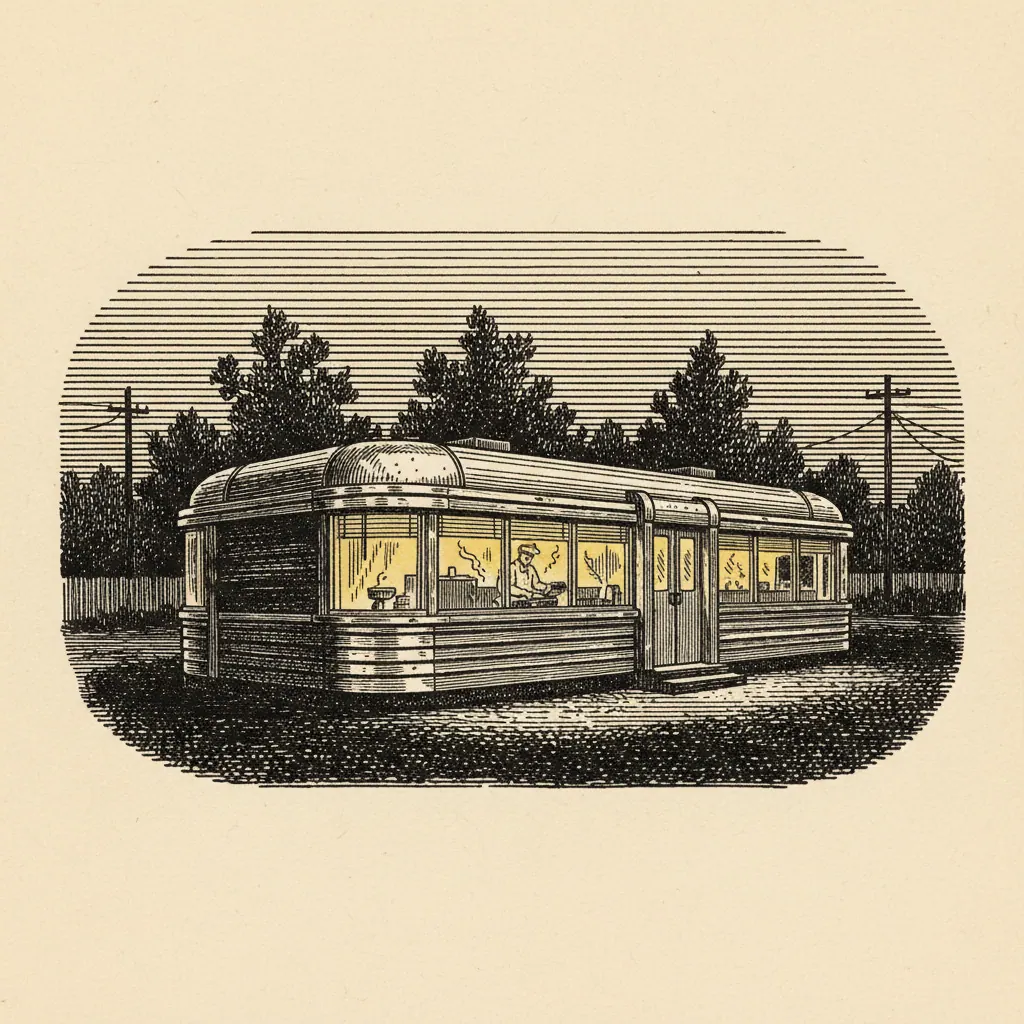
At its 1948 peak, New England had more than 1,200 diners. Fewer than 200 of the original Worcester Lunch Car and streamline-era cars are still flipping eggs. This is a field guide to the ones that made it. The math is brutal when you lay it out. The Worcester Lunch Car Company alone built 651 diners between 1906 and 1961, most of them shipped to mill towns within a day’s drive of the factory on Quinsigamond Avenue. Sterling Streamliners came out of Merrimac, Massachusetts. Fodero, Paramount, and Bramson cars rolled in from New Jersey to fill out the rest. By the late 1970s the survivors were already a minority. The fast-food box and the family restaurant chain finished off most of what was left. What stands today is a working museum that still serves breakfast.
What Counts as a Survivor
The criteria for this guide are tight on purpose. A survivor has to be built before 1965, still operating in its original manufactured car (or a structure directly attached to it, since many diners outgrew the original ten-stool car and added a back room in the 1950s), serving breakfast all day, and running a working counter where you can sit down and order without a host. Cosmetic restoration is fine. Most of the surviving cars have had their stools reupholstered three or four times by now, and a 1947 Worcester with new red vinyl is still a 1947 Worcester. The cherry-and-mahogany interiors get refinished. The booths get rebuilt. That’s maintenance, not replacement. Gut-renovation disqualifies. A 1990s building styled to look like a diner, the chrome-strip-and-neon kit you see in suburban strip malls, is not on this list, no matter how good the home fries are. One asterisk: the Friendly Toast in Portsmouth occupies a 1937 building, but the diner inside is a 1990s recreation, not the original car. It’s flagged for context, not included as an equal. If you’re chasing the streamline-era industrial heritage, the Friendly Toast is the wrong stop. If you want a good breakfast in Portsmouth, it’s still a good breakfast.
The Ten Survivors
| Diner | Town | Built | Manufacturer | Signature Order | Miles from Boston |
|---|---|---|---|---|---|
| Modern Diner | Pawtucket, RI | 1941 | Sterling Streamliner | Custard French Toast | 45 |
| Casey’s Diner | Natick, MA | 1922 | Worcester Lunch Car | Three steamed dogs, brown bread | 18 |
| Lou’s Restaurant | Hanover, NH | 1947 | Built on-site, diner-style | The Lou’s Special | 130 |
| Charlie’s Diner | Spencer, MA | 1948 | Worcester Lunch Car | Turkey hash | 60 |
| Agawam Diner | Rowley, MA | 1954 | Fodero | Chocolate cream pie | 30 |
| Lindy’s Diner | Keene, NH | 1961 | Paramount | Mac and cheese with a fried egg | 80 |
| Miss Worcester | Worcester, MA | 1948 | Worcester Lunch Car | Two eggs, hash, rye toast | 45 |
| Boulevard Diner | Worcester, MA | 1936 | Worcester Lunch Car | Sausage and peppers omelet | 45 |
| Becky’s Diner | Portland, ME | 1991* | (modern build, included as the working-fishermen counter heir) | Fisherman’s breakfast | 105 |
| Polly’s Pancake Parlor | Sugar Hill, NH | 1938 | (not a manufactured car, diner-adjacent) | Buckwheat pancakes with hot maple | 145 |
| The Modern Diner in Pawtucket is the gold standard. It’s a 1941 Sterling Streamliner, one of fewer than a dozen Sterlings still operating anywhere, and in 1978 it became the first diner ever listed on the National Register of Historic Places. The Custard French Toast is the order. Thick-sliced house bread soaked in custard, griddled, served with real maple. There’s nothing on a Denny’s menu that resembles it. | |||||
| Casey’s in Natick is the oldest and the smallest on the list. It’s a ten-stool 1922 Worcester car, no booths, no tables; you sit at the counter or you stand outside. The order is three steamed hot dogs (steamed, not grilled, in the 1922 way) and a slice of brown bread. The line on a Saturday morning runs to the sidewalk and the wait is part of the deal. | |||||
| Lou’s in Hanover is the Upper Valley holdout. Polly’s in Sugar Hill is on the list with an asterisk of its own. It’s not a manufactured car. It’s a converted 1820s carriage shed that started serving pancakes in 1938 to demonstrate the Dexter family’s maple syrup. The reason it earns inclusion is the same reason the cars earn inclusion: a working kitchen, the same era, the same ethic, and pancakes made from grain ground that morning. The buckwheat order with hot maple syrup is the move. | |||||
| Charlie’s in Spencer turns out turkey hash that justifies the drive west on Route 9. The Agawam in Rowley does a chocolate cream pie that has not been improved on by anyone in fifty years. Lindy’s in Keene serves mac and cheese with a fried egg on top that is the kind of thing a diner cook invents at 11 p.m. and that becomes a regional dish by accident. | |||||
| Miss Worcester and the Boulevard are both within a mile of where the Worcester Lunch Car Company actually built them. The Boulevard is a 1936 car still operating on Shrewsbury Street. Miss Worcester sits across from the old factory site, which is the closest thing the diner world has to a pilgrimage. |
How to Read a Survivor’s Menu
You can identify a real survivor from the menu before the food arrives. The toast plate gives it away first. House-baked bread is sliced thick and a little uneven, with a crumb that doesn’t compress flat under butter. Pre-bagged sandwich bread tells you the kitchen has given up. The maple syrup on the table should be real. The corn-syrup-and-caramel-color blend that took over diners in the 1970s (Mrs. Butterworth’s, Aunt Jemima, the off-brands in the squeeze bottle) is the single clearest tell that a diner has stopped trying. New England survivors mostly have a small pitcher of the real thing on every table, or bring it on request. The fries matter. Cottage fries, sliced rounds, skin on, fried in batches, are the sign of a kitchen that runs an in-house potato program. Waffle fries and crinkle-cut come from a food-service truck. Hash browns done right are pressed flat on the griddle and develop a crust on both sides; hash browns done wrong come from a frozen patty. The dessert case is the last test. Pies that obviously weren’t shipped frozen on a Sysco truck have crusts that look hand-crimped, fillings that aren’t perfectly level, and meringues that are slightly different heights. A row of identical pies under glass is a warning.
Why the Survivors Matter
The diner was the working-class restaurant of the Northeast for roughly 80 years. Mill workers in Lowell, fishermen in Gloucester, second-shift nurses, traveling salesmen, machinists getting off the third shift at the Springfield Armory: all of them ate at the same counter, paid the same prices, ordered off the same menu. The diner was egalitarian by design. The counter put everyone at the same height. That’s gone almost everywhere else in the American food landscape. The fast-food drive-through replaced the counter for the working shift. The chain restaurant replaced the booth for the family. What’s left of the diner is a working artifact of a regional industrial culture, one shelf over from the brick mill and the white-steeple church, and disappearing faster than either of them. The cars themselves were built to last. Most of the survivors are eighty years old now and still functional, which is not something you can say about most things built in 1944. They were over-engineered on purpose because they had to roll out of the factory on a flatbed and survive the trip. Worth reading further: Glenn Wells’s Diner Hotline, which has tracked the surviving cars for thirty years; the New England Diner Heritage project, which is doing the slow work of cataloging what’s left; and the Boston Globe diner archive, which has the best run of historical reporting on the Worcester Lunch Car Company anywhere. Plan one trip per season. Pawtucket in January when the Modern’s neon is the warmest thing on the block. Natick in May with the windows of Casey’s open. Spencer in October. Hanover in February when the Dartmouth students are back and the counter is full. The cars aren’t getting any younger, and the day will come when the list is shorter than ten.