The Asticou Inn: Mount Desert Heritage Lodging Since 1883
The 1883 summer hotel that preserves Mount Desert's heritage-lodging tradition. Croquet on the lawn, the central dining room, the Asticou Azalea Garden next door.
The Asticou Inn has been serving dinner in the same dining room, under the same chandelier, since 1883. That sentence is the entire reason to go, and the reason it isn’t for everyone. If you want a hotel that operates at the tempo of 2026, with soundproof walls and a concierge app and a rainfall shower in every bath, the Asticou will frustrate you inside an hour. If you want to sleep in the building where the history actually happened, on a hillside above Northeast Harbor, in a room that has been a guest room since Chester A. Arthur was president, this is the place on Mount Desert Island that does that. It is one of the last of its kind in Maine. That fact is doing most of the work.
What the Asticou Is, and Why It Survived
Charles Asticou Savage opened the inn in 1883 as the dining-and-lodging hub for the summer cottages going up around Northeast Harbor. The cottages were the point; the inn was the infrastructure. Wealthy families from Philadelphia, New York, and Boston were buying coastal land on the western, quieter side of Mount Desert Island, and they needed somewhere to put their dinner guests, their visiting in-laws, and the occasional overflow houseguest. The Asticou filled that role for the entire late-Gilded-Age cottage colony. Northeast Harbor was, and remains, the deliberately quieter half of Mount Desert Island. Bar Harbor caught the steamships, the grand hotels, the commercial traffic, and eventually the fire of 1947 that ended most of its 19th-century building stock. Northeast Harbor caught the Rockefellers and the Astors and the kind of money that prefers not to be looked at. The town protected itself from commercial development and largely still does. Most of its 19th-century peers, including the Rodick House, the Belmont, the original Newport Hotel, and dozens of others up and down the Maine coast, burned, were torn down, or were renovated into something unrecognizable. The Asticou’s owners since the 1990s have done quiet preservation work rather than a gut renovation. The wiring is updated. The plumbing works. The building, however, is still the building. That is the entire commercial strategy, and it is the right one.
The Building Itself
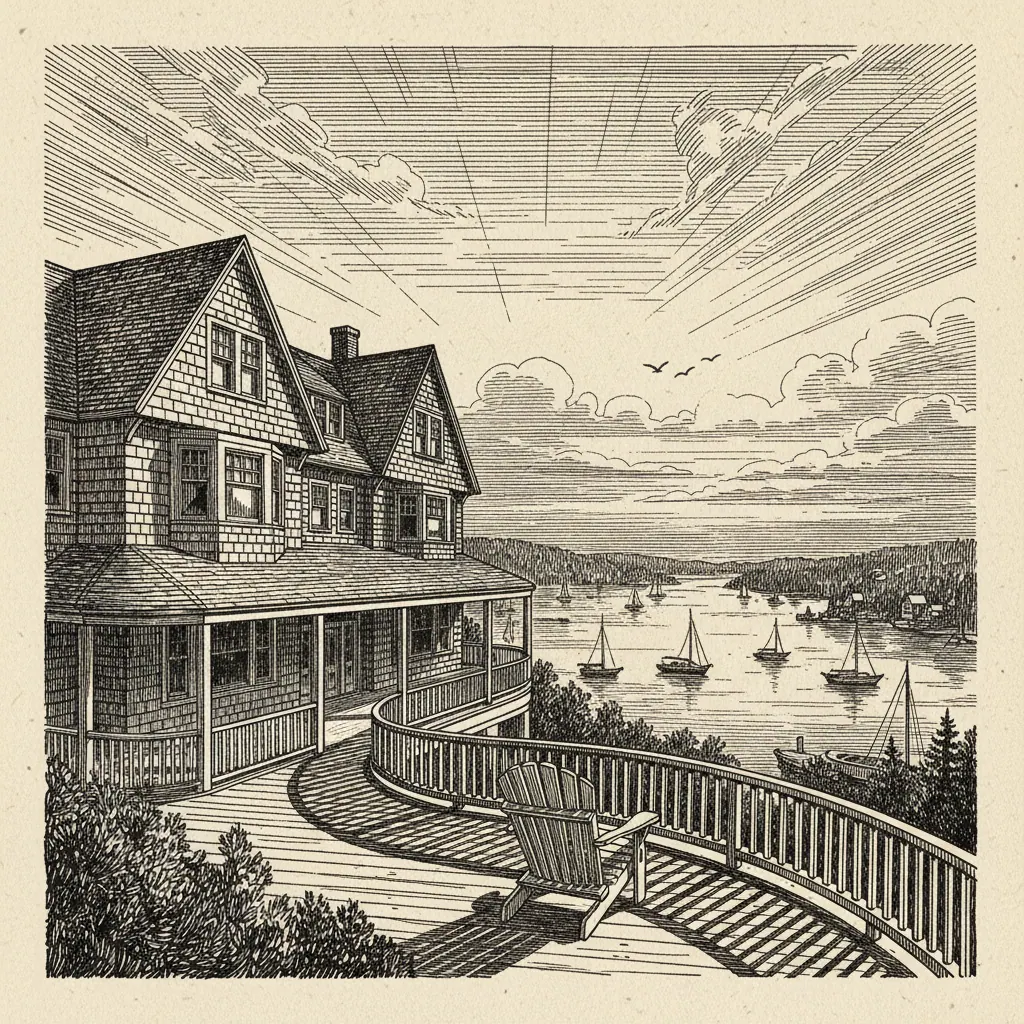
Three stories of shingle-style construction, with the wraparound porch facing the harbor and the rocking chairs that go with it. The shingle style was the late-19th-century New England seaside vernacular, and the Asticou is one of the textbook examples, Henry-Hobson-Richardson era, before the style got mannered. The central dining room still has its original 1883 wood paneling and the original chandelier. Walking into that room before dinner is the moment that earns the trip. The light through the harbor-side windows in late afternoon, falling on paneling that has been catching that same light for over 140 summers, is not a thing you can manufacture in a new building. The 47 guest rooms vary considerably, and this matters. The 1883 originals are small. They have period furniture. Some have shared baths down the hall. The renovated suites are larger, with private baths and updated finishes, and they cost accordingly. Neither is wrong; they are different products. If you are coming for the experience, ask for an original room and accept that it will be small. If you are coming for comfort, book a renovated suite and don’t pretend you came for the history. The adjacent Asticou Azalea Garden was added in 1956 by Charles K. Savage in the Japanese stroll-garden tradition, after Savage acquired the plant collection from Beatrix Farrand’s Reef Point Gardens. It is technically a separate property, run as a public garden, but it sits on the inn’s grounds and functions as part of the experience. Walk it before breakfast. The light at that hour is what Savage designed it for.
Dining and the Sunday Tea
The main dining room is open to the public for dinner, not just to guests. Jacket recommended for men, business casual for everyone else. The dress code is part of the place; the room would feel wrong with a table of people in fleece vests and trail pants, and the Asticou knows it. The menu is contemporary New England, with local fish, summer vegetables from inland Maine farms, and the standard responsible-sourcing language that every serious kitchen now uses. The food is good. It is not the reason you booked the table. The room is doing most of the work, and the kitchen is wisely staying out of its way. Sunday afternoon tea, June through September, is the move that locals make. It draws guests from across Mount Desert Island, people who aren’t staying at the inn but want an hour in the building. Book it. The harbor view from the porch with a pot of tea on a Sunday in August is a specific, finite, available experience that is hard to find elsewhere on the East Coast. Croquet on the lawn before dinner is a real thing, not a marketing line. The mallets are in a rack by the porch. Use them.
How to Book, and When
July and August rooms are typically gone six to nine months ahead. If you want peak summer, reserve in winter. If you call in May for an August room, you will be told no, politely. Shoulder season is the better play in almost every respect. May and June, and September into mid-October, have actual availability, lower rates, and arguably better light on the harbor. Late summer haze gives way to clearer Maine coast air by Labor Day, and the foliage on the carriage roads in early October is the reason a lot of people come to Mount Desert in the first place. The inn closes November through April. There is no winter operation; do not call asking. Reservations go through asticou.com or by phone, and when you book, ask specifically about which room category you are being assigned. “Standard” can mean a renovated double or a small original room with a shared bath, and the difference is large enough to matter to your trip.
Who This Is For (and Who It Isn’t)
This is not a 21st-century luxury resort. The walls are not soundproof. You will hear the couple in the next room, on a quiet night, walking across their floor. The furniture is antique, which means some of it is uncomfortable in the way antique furniture is uncomfortable. The service runs at a slower tempo than what a Four Seasons trains its staff for, because that is the right tempo for this building. Travelers who expect hotel-chain consistency will be unhappy here. They should book the Harborside Hotel in Bar Harbor or, better, the Wequassett down on Cape Cod, and have the trip they actually want. The right traveler for the Asticou is the one who would rather stay in the building where the history happened than in a new building down the road from it. The one who reads the words “1883 original room, shared bath” and feels something other than dismay. The one who understands that the chandelier in the dining room has been hanging there for 142 years and that this is the entire point. If Bar Harbor’s cruise-ship season has burned you out on Mount Desert Island, the Asticou is the corrective. The harbor is quieter. The crowds are older and fewer. The carriage roads are a ten-minute drive. The Azalea Garden is across the lawn. And the dining room at six in the evening, with the sun coming off the water through 1883 glass, is the version of coastal Maine that the rest of the island used to be and mostly isn’t anymore. Book the shoulder-season room. Bring a jacket for dinner. Walk the garden in the morning before anyone else is up.