Where The Holdovers Was Filmed: A New England Locations Guide
Where Alexander Payne's prep-school movie was actually filmed: five real New England schools, downtown Worcester, and a Fairhaven diner. A driving guide for fans of the film.
The first thing every viewer of The Holdovers asks is which prep school plays Barton Academy. The answer is none of them, and all of them. Alexander Payne stitched his fictional 1970 boarding school out of five real New England campuses, plus a Massachusetts mill town standing in for Boston, and the seams, once you know where to look, are part of the pleasure of watching the film a second time. The production was based in Massachusetts for tax-credit reasons, but the location list reads like a Pioneer Valley and SouthCoast travelogue. Five working schools, a fishing-port downtown, and a midsize industrial city all auditioned for the role of “1970” and got the part for different reasons. Here’s where to find them.
Deerfield Academy: The Face of Barton
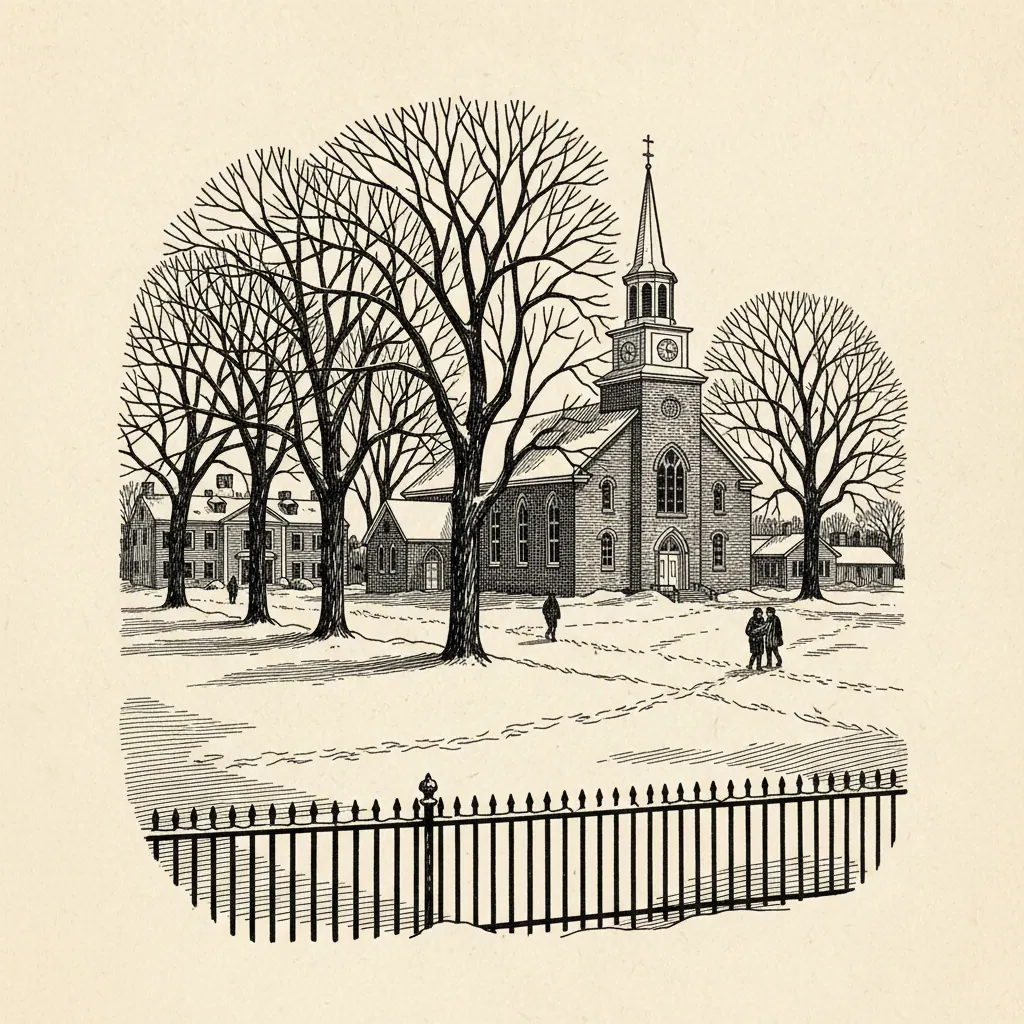
The exterior of Barton, including the quad, the dorm wings, and the long approach to the chapel, is Deerfield Academy, in Deerfield, Massachusetts. The school was founded in 1797, which matters: the federal-style brick buildings on screen are the actual federal-style brick buildings, not a soundstage approximation. The 1799 Brick Church (which the film treats as the campus chapel) and the slate-roofed Barnard House carry most of the establishing shots. When the camera pulls back to show snow-covered grounds and a row of dormer windows, that’s Old Deerfield Street. Memorial Hall Museum is open year-round and sits a short walk from the academy grounds. Deerfield itself runs campus walking tours on weekdays during the academic term. The tours are pitched at prospective families, but the school is generally welcoming about visitors who want to see what Payne saw. A practical note: in winter, when the film’s mood is easiest to recreate, the village is quiet enough that the experience feels close to what’s on screen. In leaf-peeping October, it does not.
St. Mark’s School: The Dining Hall and Library Interiors
The wood-paneled dining hall where Paul Hunham serves Christmas dinner is not Deerfield. It’s St. Mark’s School in Southborough, about an hour southeast. The library interiors and several classroom scenes were filmed there as well, according to IMDb production notes and Berkshire Eagle reporting from the 2022 shoot. The reason for the split is architectural. Deerfield’s federal-style buildings, beautiful as they are, run light and plain on the inside. St. Mark’s, founded in 1865 in the Episcopal tradition, has the gothic interior detail (dark paneling, leaded windows, a dining hall with a hammer-beam ceiling) that the film leans on for its claustrophobic Christmas-week mood. Payne needed a school that looked like a place a teenager could feel trapped in. St. Mark’s interiors did the work. The campus is private. Visitors interested in seeing the buildings should contact admissions; St. Mark’s runs appointment-based tours rather than drop-in access. Worth doing if the film captured you, less worth doing if it didn’t.
Northfield Mount Hermon: The Gymnasium and Athletic Fields
The gymnasium scenes, including the moment that opens the film’s emotional middle, were shot at Northfield Mount Hermon, in Mount Hermon, Massachusetts, back across the river from Deerfield. The long exterior shots of snow-covered athletic fields, with the campus and farmland behind, were filmed there too. NMH’s campus runs to about 1,300 acres and includes a working dairy farm, which is part of why the wide shots read so convincingly as 1970. There’s no suburban sprawl in frame because there’s no suburban sprawl on the property. The school’s older athletic facilities, the gym in particular, matched the period without much set dressing, which is the kind of practical advantage that decides locations when a production is trying to keep its art department under budget. Public access to NMH is limited to scheduled events: theatrical performances, athletic games against visiting schools, occasional concerts at Memorial Chapel. The campus is not generally open for drop-in tourism, and the film’s location is back-of-campus territory you wouldn’t reach without an invitation. Treat NMH as the location you visit on screen, not in person.
Fairhaven and New Bedford: The Town Scenes
When Mary leaves Barton for the day, she leaves the Pioneer Valley as well. The snowy small-town scenes (the storefronts, the bus stop, the bar where she has a hard evening) were shot in Fairhaven and New Bedford, on the SouthCoast. The diner scene was filmed at a working diner on the Fairhaven side of the harbor. The walking tour run by the Office of Tourism passes the diner and several of the storefronts that appear on screen. New Bedford, a few minutes across the bridge, supplied the wider streetscape (the working waterfront, the older brick blocks downtown) that gave the production the period density it couldn’t get from Fairhaven alone. The Boston Globe covered the late-2022 SouthCoast shoot, including local reaction, which ran the spectrum from delighted to mildly irritated about the parking. If you’re driving down for the day, Fairhaven is the more efficient stop for the film tour. New Bedford rewards a longer visit on its own terms (the Whaling Museum, the cobblestone historic district, a working fishing port still working) but those aren’t the reasons The Holdovers is set there.
Worcester: Standing in for Boston
Hunham and Angus’s holiday trip to Boston was not filmed in Boston. It was filmed in downtown Worcester, about forty miles west. The reasons are familiar to anyone who follows New England film production: Massachusetts expanded its film tax credit in 2007, and Worcester has, since then, become the state’s most-used Boston stand-in. The downtown has a more intact 1970 streetscape than Back Bay or Beacon Hill, with fewer glass towers, more masonry, and the kind of mid-century commercial blocks that read as period without much dressing. For a film set in 1970, Worcester is closer to 1970 than Boston is. Three specific Worcester locations carry the city scenes. The Beechwood Hotel, on Plantation Street, plays the hotel where Hunham and Angus stay. Mechanics Hall, the 1857 concert hall on Main Street, appears in one of the cultural sequences. And the diner scene during the city visit was shot at one of the downtown diners that’s appeared in several recent Boston-set productions. All three are publicly accessible. The Beechwood is a working hotel where you can book a room, eat at the restaurant, or just walk through the lobby. Mechanics Hall offers tours and is one of the better-preserved nineteenth-century concert halls in the country, worth seeing on its own merits. The diner is open daily. If there’s a single location for a Holdovers fan to make a half-day of, it’s Worcester, because all three are within a short walk and the city is a couple of hours from anywhere in southern New England. Deerfield is the postcard. Worcester is the practical visit. The film won’t release a comprehensive locations list (productions rarely do) but the public record from permits, trade reporting, and on-the-ground coverage is enough to map most of it. What’s left is the pleasure of standing somewhere you’ve already seen on screen, in the kind of New England winter light Payne spent two years chasing, and recognizing it.