The Carriage Roads of Acadia: A Cyclist's Field Guide to 45 Miles of Crushed Stone
Forty-five miles of crushed-stone carriage roads, sixteen Rockefeller-built stone bridges, and a cyclist's field guide to the named loops.
Forty-five miles of crushed stone, sixteen hand-cut granite bridges, and not a single car. The carriage roads of Acadia are the best non-paved cycling network east of the Rockies, and most visitors who drive Park Loop Road never touch them. That’s the strange thing about Mount Desert Island. The Park Loop is the postcard (Sand Beach, Thunder Hole, Cadillac at sunrise) and it earns its reputation. But the carriage roads are the actual masterpiece, and you can ride the whole network in two unhurried days without ever sharing pavement with a Subaru.
What Rockefeller Built (1913–1940)
The carriage roads exist because John D. Rockefeller Jr. did not like cars. When automobiles started appearing on Mount Desert Island in the early 1900s, Rockefeller, who summered at Seal Harbor, decided the island needed a road network the cars couldn’t reach. Between 1913 and 1940, he personally funded and supervised the construction of 57 miles of carriage roads (45 of which sit inside what is now Acadia National Park), hiring engineers and landscape architects to design routes that disappeared into the terrain rather than imposing on it. The engineering was specific and deliberate. Maximum grade of 8%, never steeper. Crushed-stone surface laid over a three-layer base (large stone foundation, smaller stone middle, fine crushed-stone top) that sheds water and packs harder over time. Sixteen bridges, each one designed by a different architect or hand-cut from local granite to fit its specific site. Sight lines engineered so the road ahead curves out of view, giving the rider a sense of always coming into a new place. What Rockefeller built for horse-drawn carriages turned out to be ideal for modern bicycles. The grades are gentle enough that a casual cyclist can ride all day. The surface is firm enough for any hybrid or gravel bike. And the routing, laid out for scenic interest first and efficiency second, is exactly the kind of network you’d design today if you were building a recreational cycling trail from scratch and had unlimited money. Friends of Acadia maintains the network now through a private partnership with the National Park Service. ## The Five Loops Worth Riding The carriage roads form a connected network, not five discrete loops, but riders generally talk about them in loops because that’s how you plan a day. Here’s the practical breakdown:
| Loop | Distance | Difficulty | Key features | Trailhead | Best season |
|---|---|---|---|---|---|
| Witch Hole Pond | 4 mi | Easy / flat | Beaver lodges, Halfmoon Pond | Park HQ, Eagle Lake | June–October |
| Eagle Lake | 6 mi | Easy / flat | Eagle Lake itself, Bubble Pond views | Eagle Lake lot, Rt. 233 | June–October |
| Jordan Pond / Bubble Pond | 8 mi | Easy–moderate | Jordan Pond House, Triple Bridges | Jordan Pond House | May–October |
| Around the Mountain | 10 mi | Moderate | Hadlock Pond, Hemlock Bridge, longest grades | Parkman Mtn lot | June–October |
| Day’s End / Hadlock Brook | 4–5 mi | Moderate | Hadlock Brook waterfalls, quietest section | Brown Mtn gatehouse | June–October |
| For first-timers, Eagle Lake and Witch Hole Pond are the two to start with. Both are flat, both are short enough to finish in under two hours, and both put you in striking range of the wildlife the network is known for: beaver lodges on Witch Hole, loons on Eagle Lake, and the occasional bald eagle working the pond surface in early morning. | |||||
| The Around the Mountain Loop is the classic full-day route. Ten miles, moderate grades, and it folds in Hadlock Pond plus Hemlock Bridge, the longest span in the system. Plan three to four hours with photo stops. The full clockwise circuit, linking all five loops together, runs about 25 miles and takes most of a day at a tour pace. It’s the route for people who want to say they rode the whole network. It is not the route for people new to cycling. |
The 16 Bridges, and the Three to Photograph
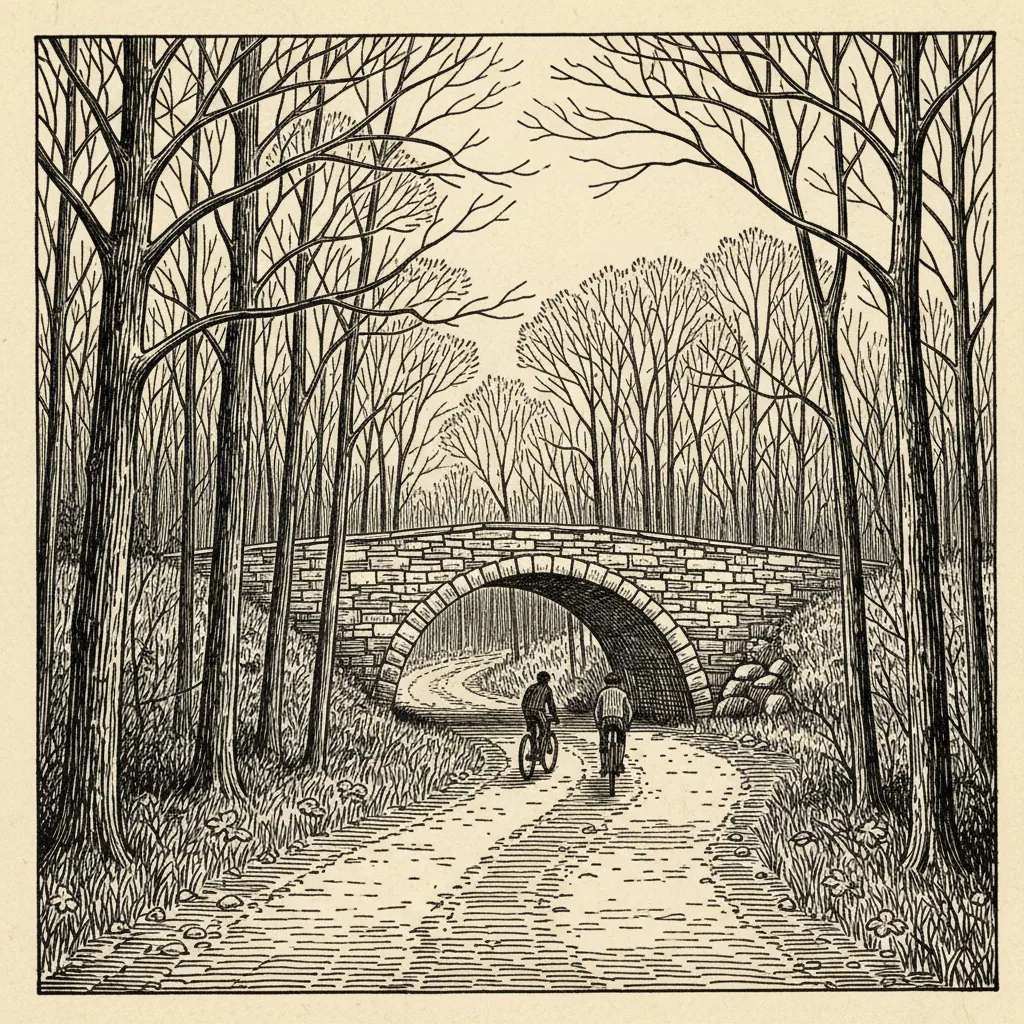
Each of the 16 bridges has its own architect and its own story, and a slow rider could spend a week chasing them. Three are worth specifically routing around. Cobblestone Bridge over Otter Brook is the only bridge in the system where the road surface itself is cobblestone rather than crushed stone. It’s the oldest bridge in the network (1917), and the cobblestones have weathered into a deep, mottled gray that photographs well in any light. It sits on the Jordan Pond / Bubble Pond loop. Triple Bridges over Jordan Stream, sometimes called Triad-Hudson Bridge, is the most architecturally ambitious of the set: three stacked stone arches in a tiered configuration, set into a hemlock grove just south of Jordan Pond. Best photographed from below the bridge in morning light, when the arches catch sun off the stream surface. Hemlock Bridge spans 67 feet across a deep mixed-conifer ravine and is the longest bridge in the network. It’s set well off the Around the Mountain Loop and gets less foot traffic than the others, which makes it the most peaceful of the three for a long stop. Look for it about three miles into the loop from the Parkman Mountain trailhead. The remaining 13 bridges are worth slowing down for as you encounter them, but these are the three to plan a route around if photography is part of the day.
Renting a Bike and Getting to the Trailhead
Two outfitters in Bar Harbor handle most of the rental traffic. Bar Harbor Bicycle Shop on West Street and Acadia Bike on Cottage Street both rent hybrids and gravel bikes by the day, half-day, or week. A hybrid is the right call for crushed stone unless you already ride gravel and own the bike fit. The carriage road surface is firm but not always smooth, and full road tires will punish you on the rougher sections. Bring a tire-repair kit regardless of what you ride; the crushed stone occasionally throws sharp shards, and punctures are routine enough that both rental shops include patch kits as a default. The Eagle Lake parking lot off Route 233 is the most central trailhead and connects to four of the five loops within the first mile. In peak season, arrive before 9 a.m. or you’ll find yourself parking back in Bar Harbor and shuttling out on the Island Explorer bus, which is free but adds an hour to the day. The Jordan Pond House lot fills earlier, usually by 8:30, because it doubles as the trailhead for the popover lunch crowd.
Season, Weather, and the Off-Season Reality
The cycling season runs mid-June through mid-October. The network never fully closes; it just changes users with the seasons. Mid-September through Columbus Day is the sweet spot. Foliage is starting to turn but hasn’t peaked, daytime temperatures are in the 60s, and the summer crowds have thinned to the point that you can ride the Eagle Lake loop on a Tuesday morning and see more loons than people. The week after Labor Day in particular is the quiet window: kids are back in school, the cruise ship traffic in Bar Harbor is steady but not overwhelming, and the rental shops have full inventory available without a reservation. A note on water: there is none on the carriage roads themselves. Fill up at Jordan Pond House if you’re routing through there, or carry what you need from the start. The longest stretch between water sources on the Around the Mountain Loop is about seven miles. Plan the next ride before you leave the island. The carriage roads are the kind of network that rewards a return trip in a different season. The same Hemlock Bridge in mid-October foliage is a different photograph than the same bridge in late-June green, and the Witch Hole Pond beaver lodges look different again in February under snow.