The New England Covered Bridge Atlas: 200 Bridges, Five States, the Engineering and the Drive
200 historic covered bridges across five states, organized by the engineering: Town lattice, Howe truss, Burr arch. The day-drives that hit multiple.
New England has roughly 200 historic covered bridges still standing, and Rhode Island has zero of them. That uneven distribution, with 100 in Vermont alone (more per square mile than any state in the country), is the first thing to understand before you plan a drive. The second thing is that the count is always slightly wrong. Bridges burn, flood out, get hit by oversized trucks, get rebuilt, get decommissioned. The registries try to keep up. The numbers below are the working consensus as of the most recent published tallies; if you’re chasing a specific bridge, call the town clerk before you drive.
The Count, by State
The rough inventory, cross-checked against the National Society for the Preservation of Covered Bridges (NSPCB) registry and the Vermont Agency of Transportation Covered Bridge Inventory:
- Vermont: ~100
- New Hampshire: 54
- Maine: 9
- Massachusetts: 7
- Connecticut: 3
- Rhode Island: 0 Vermont’s lead isn’t an accident of survival. It’s policy. The state highway department, unusually for a 20th-century DOT, kept rebuilding wooden bridges rather than replacing them with steel and concrete. That decision compounded for decades. Combine it with a 19th-century mill economy that needed a covered crossing every few miles to move grain, lumber, and woolens, and you get the densest concentration of timber-truss bridges in the United States. New Hampshire’s 54 is a respectable second. Maine’s 9 is a reminder that the working bridges of the North Woods mostly went to the saw and the river. Massachusetts kept seven. Connecticut three. Rhode Island, the smallest state, lost its last historic covered bridge generations ago.
Why the Cover, and the Engineering
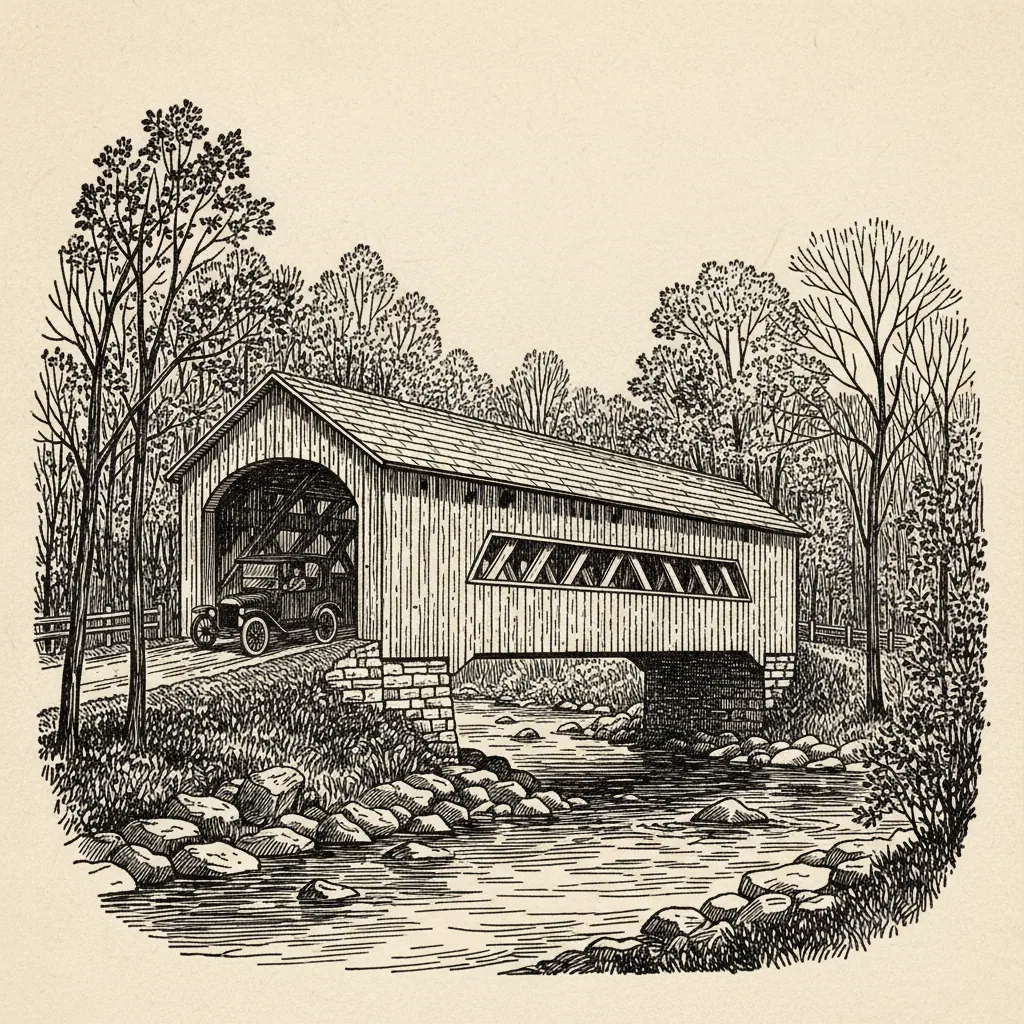
The roof and siding aren’t aesthetic. They’re structural insurance. A wooden truss exposed to New England weather has a service life of about twenty years before rot in the joints starts to compromise the load path. Cover that same truss with a roof and board siding, keep it dry, and the service life roughly triples, to sixty years and up, with proper maintenance. That’s the whole reason these bridges exist in their familiar form. The cover is a roof for the truss, not for the traveler. The truss itself is where the design choices got interesting in the first half of the 19th century: Town lattice (Ithiel Town, patented 1820) is the workhorse, used in about 70% of New England’s surviving covered bridges. Interlocking diagonal planks pinned with wooden trunnels. No metal hardware to rust. The design was famous for being buildable by a competent crew of carpenters without an engineer on site, which is why it spread so fast. Burr arch-truss (Theodore Burr, 1804) is the oldest design still in service. It pairs a multiple-king-post truss with a long arch laminated from sawn timbers. The arch carries dead load, the truss carries live load, and the combination handles spans that pure-truss designs couldn’t. Howe (William Howe, 1840) is the design that admitted iron into the equation: vertical iron rods in tension, timber diagonals in compression. It’s stiffer than Town lattice and was the standard for railroad covered bridges, which had to carry heavier loads. Long (Stephen Long, 1830) is the pure-timber predecessor to Howe, with boxed posts and counter-braced diagonals, all wood. It’s the design you’ll see called out on bridge plaques in northern Vermont and the western Whites. The maintenance cycle nobody photographs: new shingles every 25–30 years, structural inspection annually, partial truss rebuild every 60–80 years. A covered bridge isn’t a relic. It’s a piece of infrastructure on a maintenance schedule, and when the schedule slips, the bridge dies.
The Vermont Concentration
If you only have a weekend, Vermont is the answer. It’s a Town lattice, rebuilt and reinforced multiple times, and it still carries vehicles. Taftsville Bridge (Woodstock, 1836) is the oldest covered bridge in Vermont still in use. It’s a multiple king-post with an arch, a hybrid that anticipates Burr without being a textbook example of it. The bridge took serious damage in Tropical Storm Irene in 2011 and was rehabilitated and reopened. Northfield Falls is the densest covered-bridge town in New England. Four bridges within walking distance of each other, three of them on the same short stretch of road. If you want to see the variety of the form without driving all day, this is where to do it. The Quechee Gorge bridge is the popular stop because the gorge itself is the spectacle. Worth knowing: Quechee Gorge is steel, not covered. The covered bridges in the area are nearby but not at the gorge overlook itself.
The New Hampshire Crown Jewels
New Hampshire’s 54 are concentrated in the upper Connecticut River valley, the Whites, and the Monadnock region. Bath-Haverhill Bridge (Bath, NH, 1827) is claimed by New Hampshire as the oldest covered bridge at its original location in continuous use in the United States. Vermont and Pennsylvania have competing claims for “oldest” depending on how you count rebuilds, relocations, and continuous service. New Hampshire’s argument rests on the original-location and continuous-use criteria, which Bath-Haverhill satisfies. Albany Covered Bridge (Albany, NH, 1858) is the obligatory Kancamagus Highway stop. The Kanc parking on the south side fills first because that’s the side with the trailhead. North side is usually open if you arrive after the first wave. Honeymoon Bridge in Jackson, NH (1876) carries a name that is real and predates the marketing. It’s a Paddleford truss, a New Hampshire-specific design that’s an evolutionary cousin of the Long truss, with reinforcing arches added later. The Cornish-Windsor question, of whether it counts as Vermont’s or New Hampshire’s, gets answered in the convenient way by both states. Vermont counts it. New Hampshire counts it. The 100 + 54 totals double-count it. If you want a clean number, subtract one from whichever state you’re not currently standing in.
Four Day-Drives That Hit Multiple
Stark Loop (NH). Six covered bridges in roughly 90 minutes of driving, anchored on the Stark Bridge over the Upper Ammonoosuc. Stark itself is a small town with an outsized concentration; the loop pulls in nearby crossings in Groveton, Northumberland, and Lancaster. Brownington–Greensboro Loop (VT Northeast Kingdom). Four covered bridges plus the Old Stone House Museum in Brownington. The Northeast Kingdom drives reward people who don’t mind dirt roads; bring a paper map, the cell coverage is honest about its limits. Quechee–Woodstock–Taftsville. Three covered bridges along one of the better foliage drives in the state. Taftsville first if you’re coming from the east, Woodstock village in the middle, then north to Quechee. The whole loop is under 20 miles. Northfield Falls walking circuit. Four bridges on foot, no driving between them. Park in the village, walk the circuit, and you’ll have seen more covered bridges in an hour than most visitors see in a week.
What’s Been Lost, What’s at Risk
Bartonsville Bridge (VT) is the case study in modern reconstruction. The reconstruction cost millions and was funded through a combination of FEMA disaster relief, state appropriations, and private donations including a community fundraising campaign. The replacement is a working bridge, built to original specifications using traditional joinery, not a museum piece. Boston Five Cent Savings Bridge is the counter-example. Closed and removed in 2002. Sometimes removal is the answer when the structure is past saving and the funds aren’t there. The slow-motion crisis isn’t dramatic floods. It’s deferred shingle replacement and underfunded structural rebuilds across the inventory. A bridge that should have been re-shingled in 2015 and got pushed to 2025 is a bridge with ten extra years of moisture in its truss. Multiply that across 200 structures and the math gets ugly. Where to direct support: the National Society for the Preservation of Covered Bridges is the umbrella organization. State-level groups, including the Vermont Covered Bridge Society and the New Hampshire Covered Bridges advocacy under the state DOT preservation program, do the on-the-ground work. Membership dues and targeted donations toward specific bridge restoration funds tend to do more than general conservation giving, because covered-bridge maintenance is item-line work: shingles, siding boards, truss timbers, each with a known cost. The next twenty years will determine which 200 becomes 180, and which becomes 150. The bridges that get re-shingled on schedule will be standing for the bicentennial of their first construction. The ones that don’t, won’t.