The New England Christmas Tree Farm Map: Where to Cut Your Own
350 cut-your-own Christmas tree farms across New England, organized by state with species, hours, and pricing. When to go and what to bring.
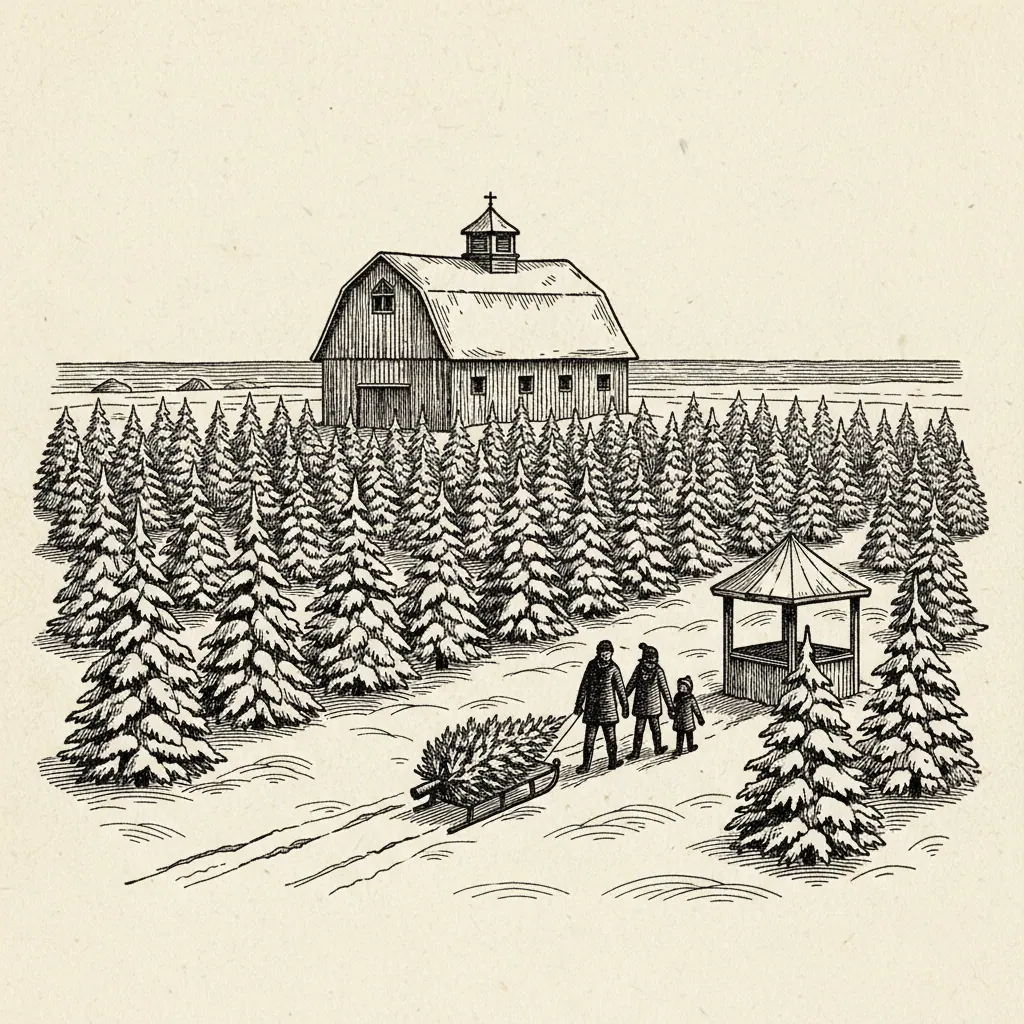
There are roughly 350 cut-your-own Christmas tree farms scattered across New England, and the difference between a Fraser fir that holds its needles into February and a white spruce that’s bare by New Year’s Day often comes down to which farm gate you pulled into the first weekend of December. The species you go home with matters more than the wreath on the door, and most families pick a farm before they pick a tree, which is backwards. This is a directory, but it’s also an argument: cut-your-own is worth the drive, and the drive is worth planning.
Why the Species Choice Matters Before the Drive
Most NE farms have shifted toward Fraser fir over the last fifteen years, and there’s a reason. Fraser holds its needles ten to twelve weeks indoors with reasonable watering, the branches are stiff enough to carry heavy ornaments without sagging, and the needles are soft enough that decorating doesn’t draw blood. If you put your tree up the weekend after Thanksgiving and take it down the weekend after New Year’s, Fraser is the species that survives the assignment. Balsam fir is the scent most New Englanders mean when they say Christmas tree. It’s the smell of every grandmother’s living room from Bangor to Bridgeport. The trade-off is shorter indoor life (six to eight weeks before it starts dropping in earnest) and softer branches that complain about heavy glass ornaments. If you’re putting the tree up on December 15th and the smell is the whole point, balsam is correct. Concolor fir is the sleeper pick. The needles have a faint citrus note when you crush them, the color is blue-green rather than the standard dark green, and it holds nearly as well as Fraser. Households tired of the balsam-or-Fraser binary should ask whether the farm has any concolor in the field. Many NE growers plant a half-acre of it for exactly the customer who shows up asking. White spruce and Scotch pine round out the bargain category. White spruce is honest about what it is: cheap, fast-growing, and dropping needles by Twelfth Night. Scotch pine holds longer than spruce but the needles are stiff and the silhouette is denser than what most NE families grew up with. Both have their place. Neither is what you drive ninety minutes for.
The Map, by State
The directory below is the working list. Each entry needs a call-ahead the week of your visit. These are family operations, and a wet November can push opening day by ten days.
Massachusetts
The central and southeast concentration is the densest in NE. | Farm | Town | Species | 2025 hours | 2025 price (7 ft) | Last verified | |---|---|---|---|---|---| | Wagon Hill | Deerfield NH | Fraser, balsam | n/a | n/a | n/a | | Joppa Hill | Bedford | Fraser, balsam, concolor | n/a | n/a | n/a | | Schaer’s Christmas Trees | Acworth | Balsam, Fraser | n/a | n/a | n/a |
Vermont and Maine
This is the drive-for-it tier. The trees are typically a dollar or two cheaper than the southern NE farms, the fields are larger, and the experience is closer to what cut-your-own meant in 1985.
| Farm | Town | Species | 2025 hours | 2025 price (7 ft) | Last verified |
|---|---|---|---|---|---|
| Frost Hollow | Pittsfield VT | Balsam, Fraser | n/a | n/a | n/a |
| Robinson Meadow | Townshend VT | Balsam, Fraser | n/a | n/a | n/a |
| A&S Tree Farm | Sebago ME | Balsam, Fraser | n/a | n/a | n/a |
| Pierce Tree Farm | Saco ME | Fraser, balsam | n/a | n/a | n/a |
Connecticut
The closest cut for the NYC-adjacent end of New England.
| Farm | Town | Species | 2025 hours | 2025 price (7 ft) | Last verified |
|---|---|---|---|---|---|
| Maple Row | Easton | Fraser, Douglas, white pine | n/a | n/a | n/a |
| Jones Family Farms | Shelton | Fraser, balsam, white pine | n/a | n/a | n/a |
Pricing and What’s Actually Provided
Cut-your-own runs roughly $50–$95 for a seven-foot tree across NE in the 2025–2026 season. Pre-cut at the same farms (trees the staff felled earlier in the week) runs $70–$120. The $20 gap is the labor of choosing, and for most families that’s the whole point of the trip. Most farms supply the saw at the parking lot, the wagon or tractor ride to the field, and the bale-and-twine at the gate when you come back out. Some throw in cocoa, a barn fire, or a goat to look at; some don’t. The National Christmas Tree Association tracks average grower pricing nationally, and state-level associations publish annual member surveys worth checking before you assume a farm is overcharging. NE prices have moved up about $10 on a seven-footer since 2022, in line with broader cost-of-business shifts at small ag operations. What to bring:
- Gloves. The saw handles are usually fine but the tree trunk is sap.
- A tarp for the roof of the car. Most farms don’t supply one.
- Your own twine as backup. The farm twine is usually adequate, occasionally thin.
- A thermos. The cocoa line at peak hours is twenty minutes.
- Boots that handle a muddy back acre. The good trees are never near the parking lot.
When to Go (and How to Beat the Rush)
The first three weekends of December are peak. Many farms run out of the optimal six-to-eight-foot Fraser inventory by the second Saturday. The four-foot trees and the eleven-foot trees stay around longer, but the standard living-room size moves fast. Several farms run November tag-and-return programs. Walk the field the weekend before Thanksgiving when the leaves are off and the trees are easy to see, tie a numbered ribbon to the one you want, then come back the first weekend of December to cut it. Maple Row, Carlson’s, and Joppa Hill are among the farms that have run tag programs in recent seasons; confirm the dates each October because the program windows shift. The under-used sweet spot is a weekday cut in early December. Full inventory, no line at the baler, and the field staff have time to actually help you find what you’re looking for. If you can take a Tuesday morning off, take it. Late-season cuts after December 15th work for short-life species (balsam, white spruce, Scotch pine) where you’re putting the tree up late anyway and taking it down by January 2nd. The Fraser inventory by mid-December is whatever didn’t sell, which is usually whatever had a flaw the early shoppers spotted.
How to Read the Directory and Verify Before You Drive
Each entry above includes a last-verified date, and a 2023 listing is not a 2025 reservation. Hours, species selection, and pricing all shift year to year. Call ahead the week of your visit. NE Christmas tree farms are family operations almost without exception, weather-dependent, and a single bad week of November rain can push opening day from the Friday after Thanksgiving to the second weekend of December. Three state grower associations maintain member directories worth cross-checking against this map: the Massachusetts Christmas Tree Association, the New Hampshire–Vermont Christmas Tree Association, and the Connecticut Christmas Tree Growers’ Association. Each publishes a free online directory updated for the current season, and each runs a member newsletter that’s the best source for closures, ownership changes, and weather-driven schedule shifts. This map gets re-verified each October. If you spot a closure, a price change, or a farm that’s added concolor to the field, the contact form sends to the editor directly. The directory is only as good as the last call made, and next October, that’s the work.